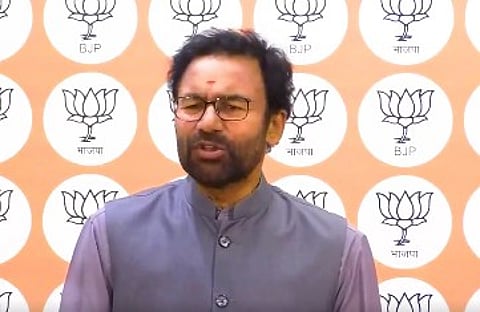

HYDERABAD: Union Minister G Kishan Reddy on Friday strongly criticised the remarks made by AIMIM chief Asaduddin Owaisi on the issue of passports and citizenship, describing them as “legally incorrect and misleading.”
In a press statement issued here, Kishan said: “As a public representative and a trained barrister, Owaisi was expected to understand the clear legal distinction between a passport and citizenship.”
“He either lacks understanding of the law or is deliberately trying to mislead the public for political reasons,” he alleged.
Referring to the recent observations made by the Ministry of External Affairs, he said that the clarification does not imply that an Indian passport is worthless.
“Rather, it reiterates the long-established legal position that a passport by itself is not conclusive proof of citizenship,” he said, while emphasising that citizenship is governed by the Constitution and the Citizenship Act, 1955, and cannot be established solely through any single document.
Kishan also pointed out that passports are issued under the Passports Act, 1967, primarily as travel documents. “Section 20 of the Act empowers the Union government to issue passports or travel documents even to non-citizens in cases where it is deemed to be in the public interest. Therefore, a passport cannot be treated as absolute proof of citizenship in every circumstance,” he said.
The Union minister further stated that this legal position is not new and has existed since the enactment of the Passports Act in 1967 under the then Congress government.
“Blaming the present Narendra Modi government for a legal framework that has existed for nearly six decades indicates ignorance or a deliberate attempt to conceal the truth,” Kishan added.
Referring to judicial precedents, Kishan said that citizenship under the Citizenship Act, 1955, is acquired through birth, descent, registration, or naturalisation.
He cited a 2013 judgment of the Bombay High Court, which held that a passport, along with documents such as Aadhaar and birth certificates, cannot by itself conclusively establish citizenship, adding that other high courts have upheld similar principles.
“The MEA has announced no new policy. It has merely reiterated a position that has long been settled by law and judicial interpretation,” he said, urging people’s representatives to exercise responsibility while commenting on matters related to citizenship and constitutional law.
He also advised Owaisi to carefully study the Citizenship Act, 1955, and the Passports Act, 1967, before making statements that could mislead the public.
