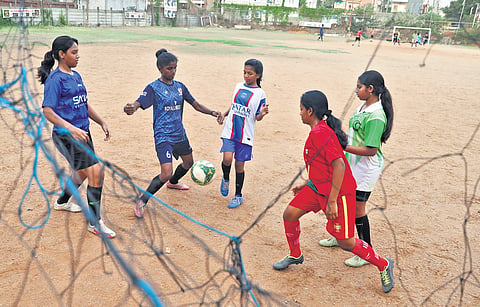

HYDERABAD: Years ago, a young girl stood on the edge of a dusty football ground in Valluvar Nagar, waiting for someone to let her play. Most days, she was told there were no girls on the field and that she should go home. She stayed anyway. When she finally got her chance, she made sure it counted.
Today, on the same ground in Sainikpuri, Secunderabad, nearly 90 boys chase a football every evening. Scattered among them are around seven to 10 girls. Their numbers may still be small, but they represent a quiet shift in a neighbourhood where football has long been more than just a game.
Valluvar Nagar, home to a large Tamil-speaking community, is known in football circles as “Mini Brazil”. The nickname reflects a passion for football that has been passed down through generations. Parents introduce the game to their children, former players return to coach youngsters, and football conversations flow easily from homes to street corners.
That passion is perhaps most visible whenever a FIFA World Cup comes around. Streets are lined with the flags of Argentina,Brazil and Portugal, giant flex banners and cut-outs appear across the locality, and residents gather around big screens to cheer for their favourite teams.
Now, football culture is slowly making room for a new generation of players. Alongside the boys who have long dominated the field, a growing number of girls are finding their place,inspired by one player who refused to stay on the sidelines.
The girl who changed the game
Before she became a national-level footballer, Ranganathan Keshwardhini, better known as Mary, was simply a young girl who loved watching others play. She would stand near the boundary as older boys played cricket. When she told her father she wanted to play cricket,he encouraged her to try football instead.

Mary still remembers waiting on the sidelines for someone to invite her into a football game. “They would sometimes ask me to go away, saying there are no girls here, why are you coming? But I kept going to the ground waiting for my chance. I proved myself when I got a chance and from then on, I was playing with the male team,” she recalls.
Soon came another milestone. “I wore boots for the first time and went for the selections for the district team and got selected,” she says.
Her father, a football player, and her mother, a former hockey player, stood firmly behind her despite the financial burden of travelling for tournaments and selections. They also faced pressure from relatives who questioned why they were sending their daughter to a football ground.
Mary continued regardless. Inspired by Cristiano Ronaldo, her favourite footballer, she went on to represent Telangana at the national level and became one of the locality’s most recognised footballers, known for her man-marking skills.
When asked what kept her going, her answer is simple. “My family’s financial condition, my coach’s hope, my passion for the game, kept me going.”
One girl’s journey inspires many more
Mary’s success did more than earn medals. It changed minds. Coach PD Joshua remembers how difficult it once was to convince families to allow girls to play football. He recalls personally speaking to Mary’s family and encouraging them to support her football ambitions. “Mary was the first girl from our area to play football. Her journey inspired many other girls to come to the ground,” he says.
As parents watched her progress through district and national competitions, attitudes slowly began to change across the locality. Girls who had once watched from the boundary lines started joining training sessions, gradually building a girls’ football culture of their own.
Before the COVID-19 pandemic, around 20 to 22 girls regularly trained in Valluvar Nagar. For the first time, the locality appeared to be building a sustainable pipeline of women footballers.
Then the pandemic interrupted that progress. Training stopped, studies took priority, and jobs and family responsibilities pulled many girls away from the game. When football resumed, only around seven to 10 girls returned to regular training.
Yet, those numbers continue to carry hope.
Among them is S Suhana, an 11th standard student at Bhavan’s Junior College, Sainikpuri, who currently represents Rangareddy district. “My dream is to become one of the best footballers and represent India,” she says.
Like many children in Valluvar Nagar, football runs through her family. Her grandfather, uncles and brother all played the game. She believes Mary’s journey showed girls that football was a dream worth pursuing. “Earlier, there was no girls’ team, which made the parents hesitant to send their girls to play. Many girls joined only after seeing Mary akka play and succeed. She supports us a lot in the ground.”
Suhana now hopes to inspire the next batch herself. “I regularly encourage my friends to take up the sport, and I hope more will join in the coming years,” she says.
Parents say Mary’s success also changed how they viewed girls’ football. K Mamtha Ravi, whose daughters Anisha Ravi (15) and Ananya Ravi (16) train regularly, believes sport helps children become physically fit, energetic and confident. Anisha and Ananya began football training when they were in Class four and Class three, respectively. Both now dream of representing India.
Former football player Sherly, who now works at an MNC, believes the locality is witnessing an important transition. “There was always a strong boys’ football culture here, but there was no active girls’ team,” she says. “When parents saw Mary reach higher levels, they started believing that their daughters could also play.”
A relay that has lasted six decades
The girls’ story is only the latest chapter in a football tradition that began in the late 1960s. Coach PD Emmanuel describes Valluvar Nagar’s football journey as a relay race. “Football has been passed from one generation to the next like a relay,” he says.
What began as senior players coaching youngsters has grown into a structured programme with nine certified coaches. Over the years, the ground has become more than a place to train. It has helped generations build careers through sports quotas.
“Earlier, many youngsters in the area were vulnerable to bad habits, including drug abuse and other negative influences. But once they started coming to the football ground regularly, we saw a remarkable change,” Emmanuel says, adding that the ground became a safe space where children learnt discipline, developed purpose and spent their time productively.
The road ahead
The club’s focus now is on ensuring that every talented player gets a chance to progress, regardless of financial limitations. Training continues free of cost, thanks to the support of former players and community elders who help meet equipment and other expenses. While Chief Minister Revanth Reddy has sanctioned funds to improve the government ground, the club hopes to see stronger infrastructure in the years ahead.
Private academies often charge between `2 lakh and `4 lakh, putting them beyond the reach of many families. Emmanuel says the club instead works to identify promising players and help them continue their football journey.
More girls are stepping onto the field than ever before. However, opportunities still remain fewer than those available to boys, with limited leagues, tournaments and competitions making long-term careers more difficult.