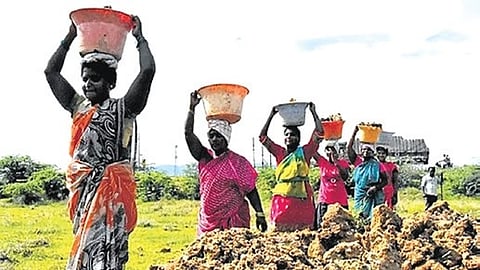

HYDERABAD: Even as civil society organisations urged the state government to enact its own employment guarantee law instead of adopting the Union government’s proposed framework, the Cabinet sub-committee set up by the state to examine the VB GRAM G Act has decided to reach out to non-BJP-ruled states to explore coordinated legal and political action.
The state Cabinet is expected to take a decision on July 2 on whether Telangana should adopt the Centre’s framework, enact its own legislation, move the Supreme Court, or pursue a combination of legal and administrative measures.
The sub-committee, headed by Civil Supplies Minister N Uttam Kumar Reddy, proposed consultations with the chief ministers of Karnataka and Kerala to assess whether the two states would be willing to pursue a common legal strategy or other coordinated measures to protect the powers and financial interests of states.
The meeting was attended in person by Panchayati Raj Minister Danasari Anasuya (Seethakka), while Agriculture Minister Thummala Nageswara Rao and Labour Minister G Vivek Venkataswamy participated virtually.
During the meeting, members of the sub-committee maintained that the proposed law infringes upon the constitutional powers of states and contains several provisions that may not withstand judicial scrutiny. Legal experts informed the panel that they had identified multiple constitutional issues that could form the basis of a challenge before the Supreme Court.
The committee also discussed whether Telangana should challenge the legislation in the Supreme Court instead of implementing it in line with the Union government’s guidelines.
Representatives of nearly 20 civil society organisations who attended the meeting criticised the Union government for introducing sweeping changes without consulting state governments.
Activists to TG: Enact own job guarantee law
The organisations urged the state government to enact its own employment guarantee law under the Constitution instead of adopting the proposed Centre's framework, which they estimated could cost the state exchequer nearly Rs 2,500 crore. They also warned that the proposed changes could reduce employment opportunities for thousands of agricultural labourers.
They opposed the proposal to limit employment to 60 days and demanded that Telangana guarantee at least 200 days of wage employment every year, along with payment of statutory minimum wages. Much of the discussion centred on the proposed 60:40 funding pattern between the Union government and the states, with the committee deciding that the Legal department should examine the issue before any final decision is taken.
Members of the sub-committee also criticised the proposed allocation formula, arguing that it would penalise better-performing states while rewarding poorer performers. They noted that Telangana had already submitted suggestions to the Union government seeking changes to the formula but expressed disappointment that these recommendations were reportedly ignored.
The committee also felt that the wider political and administrative implications of the proposed legislation had not been adequately communicated to the public.
