
ADILABAD: For most families, a wedding symbolises celebration and togetherness. Yet in many parts of India, it has also become a source of financial strain. Rising expenses, often driven by long-standing customs, push families, especially those of the bride, into years of debt.
In more than 125 tribal habitations across the erstwhile Adilabad district, however, communities are rewriting that narrative.
Instead of exchanging gifts at weddings, villagers now contribute cash through a structured door-to-door collection, ensuring marriage celebrations do not burden families financially.
The initiative, adopted through resolutions passed by local Rai Centres around 2015, involves village elders, patels and community leaders coordinating the process. Before each wedding, villagers meet and fix a contribution — usually `200 or `300 per household.
Volunteers then collect the amount from every home and hand the pooled funds to the families a day or two before the ceremony, helping cover basic expenses and reducing the need for borrowing.
The practice is now followed in several mandals, including Narnoor, Gudihathnoor, Indervelli, Sirikonda, Echoda, Utnoor, Kerameri, Asifabad and Wankidi.
Kova Daulath Rao, state president of Adivasi Sena, tells TNIE that the idea emerged from discussions within tribal communities. “Earlier, villagers would give household gifts that often had little practical use. Contributing money directly helps families meet wedding expenses,” he says.
According to him, the process begins with a village meeting about a week before the wedding to finalise the contribution amount. The funds are then collected door to door and handed over shortly before the ceremony.
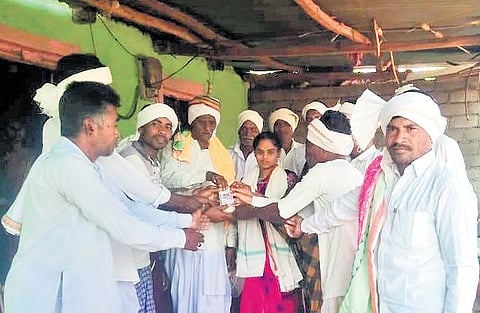
Recently, in Ginnedhari village of Indervelli mandal, Rai Centre heads, patels and villagers passed a similar resolution and provided financial support to a family ahead of a wedding, with every household contributing equally.
Thodasam Amruth Rao, district president of the Rai Centres, known locally as Sir Medi, says the system was introduced to ease the burden on families. “Marriage arrangements often place financial pressure on households. Through this contribution system, the community supports both sides,” he adds.
In Lokari village, which has around 140 families, residents recently pooled `69,000 for a wedding, giving about 60% to the bride’s family and 40% to the groom’s family. In Gumanpoor village of Lingapur mandal, villagers contributed `48,000, while in Kamdov village, the community collected `44,100 for a wedding.
Community organisations have also begun promoting simpler wedding practices. Last year, the Rajgond Seva Samithi in Kerameri mandal passed resolutions encouraging smaller gatherings, discouraging liquor during ceremonies and avoiding extravagant decorations or DJ systems. The measures also promote traditional wedding processions instead of vehicles and favour financial contributions over material gifts.
Community leaders say such steps not only preserve traditions but also ensure marriages remain meaningful without pushing families into debt.
