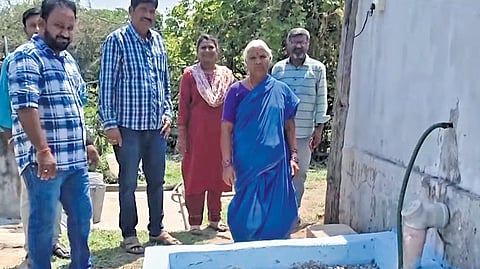

ADILABAD: They are not engineers or hydrologists, but farmers, labourers and homemakers in a small village who chose to solve their own water crisis. In Mudhigunta village of Jaipur mandal in Mancherial district, around 400 families built soak pits, planted trees and revived local water systems — turning conservation into a community movement. Their efforts found mention in the 132nd episode of Prime Minister Narendra Modi’s Mann Ki Baat on Sunday.
The initiative, begun in 2016, has steadily improved groundwater levels since 2020. Data shows pre-monsoon levels improved from an average of 5.35 metres below ground level (mbgl) during 2016–19 to 3.35 mbgl during 2020–25, while post-monsoon levels rose from 2.55 mbgl to 1.84 mbgl.
Alongside soak pits, villagers developed ponds and took up plantation drives, reducing water contamination.
Groundwater analysis
Groundwater data shows a clear improvement over the years. In 2016, pre-monsoon (May) levels were at 5.6 metres below ground level (mbgl), while post-monsoon (November) levels stood at 2.29 mbgl, with a fluctuation of 3.31 metres, indicating a deep and stressed water table.
By 2020, conditions had improved, with pre-monsoon levels at 3.32 mbgl and post-monsoon levels at 1.77 mbgl. The fluctuation reduced to 1.55 metres, reflecting better recharge. In 2025, pre-monsoon levels were recorded at 3.61 mbgl and post-monsoon levels at 1.56 mbgl, with a fluctuation of 2.05 metres, indicating sustained recovery.
Overall, the period from 2020 to 2025 shows a rising water table and significant improvement in groundwater levels. Reduced fluctuation suggests improved recharge stability.
Groundwater extraction has also declined. In 2019–20, annual availability was 96 Ha.M, with extraction at 86 Ha.M, translating to 89%. By 2024–25, availability increased to 230 Ha.M, while extraction stood at 110 Ha.M, reducing the extraction stage to 47%, indicating a shift towards sustainable usage.
Model of water conservation
Additional Collector (Local Bodies) P Chandriah visited the village to review progress after the PM’s mention. Villagers say the change was driven by collective effort. “Officials guided us initially, but everyone came together to build soak pits. Now the water levels have improved,” said D Pandari.
What began as a local response has now emerged as a model of community-led water conservation.
