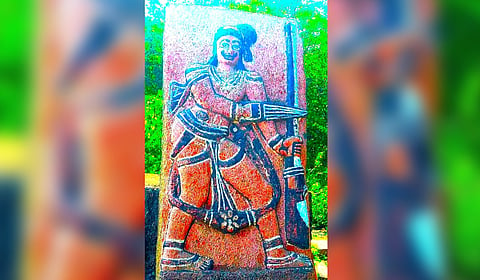

HYDERABAD: A heavily built warrior with a prominent moustache, holding a dagger in his right hand and a musket in his left, with a sword tucked into his waist and his hair tied in a bun — a sculpture near the western entrance of Warangal Fort is believed to depict Telangana warrior Sarvai Papanna, according to historian Sriramoju Haragopal.
Haragopal, president of Kotha Telangana Charitra Brundam, said the sculpture’s distinctive features and historical context supported the identification.
The sculpture shows the warrior in traditional battle attire, with a necklace and his hair tied in a bun tilted to the left. Haragopal said its artistic style suggested that it dated back to the 17th or 18th century. Its depiction of traditional weapons and battle attire, viewed alongside historical accounts of Papanna’s military campaigns, lent weight to the identification, though it remained a historical interpretation.
He linked the sculpture to Papanna’s capture of Warangal Fort on April 1, 1708. Historical accounts state that Papanna reached the fort on March 31 with 3,000 infantry and 500 cavalry. While one section of his army blocked roads and guarded approaches to the fort, another scaled its walls using ropes. His troops then broke open the gates and took control. Following the capture, Papanna’s forces looted shops, merchants and residents for two to three days, seizing large quantities of wealth and textiles. They also took several prominent people hostage and moved them to Khilashapur, where they were imprisoned. Those captured reportedly included women, children and Warangal’s Qazi, along with his family.
The wealth acquired during the campaign helped him strengthen his military capabilities. He later procured weapons and other war supplies from Dutch and English traders. Following his military successes, Papanna assumed the status of a ruler, maintaining a palanquin, a personal royal guard and a specially designated horse.
