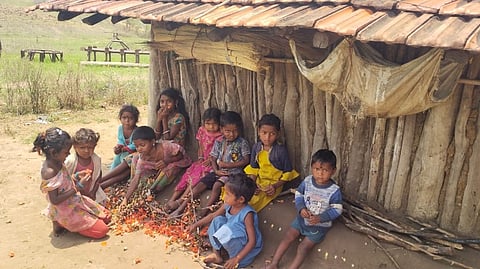

HYDERABAD: Their story is one of neglect and deprivation. Displaced from Chhattisgarh and having migrated to Telangana owing to the conflict between Maoists and Salwa Judum, the vulnerable Gotthi Koyas are unable to lead a decent life as they are denied access to development activities, welfare schemes, and, most importantly, to education due to various reasons.
A comprehensive study titled “Understanding the Status of Gotthi Koya Internally Displaced Persons (IDP) Children for Promotion of Child Welfare in Telangana” has thrown up startling facts of deprival and vulnerability with just 64% of them entering school and a mere 3% of them studying beyond high school.
The first such study was conducted by the Centre for Economic and Social Studies (CESS) in collaboration with the Bal Raksha Bharat (globally known as Save the Children) in July 2023 covering 3,250 households in 121 settlements spanning 17 mandals in three districts of Telangana Jayashankar Bhupalapally, Mulugu and Bhadradri Kothagudem.
The report says that 71% of these displaced Gotthi Koyas have voter cards and 83% of them have Aadhaar cards while a mere 1% are able to receive pensions.
According to the study, 94% of the surveyed population migrated from Chhattisgarh, a third of them arrived in Telangana to protect themselves and their youth from the conflict between Maoists and the Salwa Judum.
Fewer than a fourth arrived after the peak conflict period, with migration continuing even after the ban on the Salwa Judum in 2011, the report says.
Lack of access to education
About 40% of the population comprises children, and 10% are aged 46 and above. Educationally, nearly 59% of the population is illiterate, 27% have had some exposure to schooling, and just over 25% have attained education ranging from the primary level up to graduation and technical training.
“That these families engage only 9% of their school-going children in labour is testimony to their inclination to get them educated. But the fact that 35% of the students are forced to travel nearly a kilometre, while 50 of them have to travel up to 30 km, is the main factor behind the high drop-outs,” says Prof Bharath Bhushan Mamidi of the CESS.
Half of the surveyed population falls within the 19 to 45 age bracket, pointing to the migration of working-age individuals over the past two decades.
While over 47% of the community is part of the workforce, 46% engage in subsistence agriculture, 20.4% supplement their cash income by collecting Non-Timber Forest Produce (NTFP).
Practising podu cultivation, a vast majority (87.3%) hold land parcels of up to five acres, while 27.8% hold up to 10 acres and 10% cultivate more than 10 acres. To further support their livelihoods, families rear sheep, pigs, ducks and poultry, and sell goats at weekly local markets.
Institutional healthcare
Access to institutional healthcare remains in an abysmal state, with 75% of childbirths taking place at home. Unassisted home deliveries pose severe risks to both mother and child, resulting in stillbirths and postnatal complications affecting mothers, neonates or both 52%, 34.5% and 13.1% of cases, respectively.
Despite high rates of basic documentation, official exclusion persists. While 83.7% hold Aadhaar cards and 82% possess White or Antyodaya ration cards, only 3% of eligible women are enrolled in Women’s Self-Help Groups (SHGs).
Furthermore, while 71% of the eligible population hold voter ID cards and can vote locally, they are barred from contesting elections as ST representatives. Birth and caste certificates, which are critical for securing school and college admissions, are possessed by a mere 6% of the population.
Nonexistent infrastructure
Basic infrastructure and sanitation remain virtually nonexistent. The Swachh Bharat mission has failed to reach these settlements, with open defecation remaining the norm in 95% of households. In five of the surveyed mandals, not a single household has electricity.
The community also faces severe state harassment and legal vulnerability. Almost all internally displaced persons (IDPs) are burdened by litigation costs stemming from cases filed against them by forest officials or the police.
Caught between warring factions, many adults are branded as either “police informers” or “extremist sympathizers” and are forced to report weekly to the nearest police station, where they are often subjected to forced labour.
The study notes that those who arrived in these settlements more recently face significantly higher risks than those who migrated earlier.
