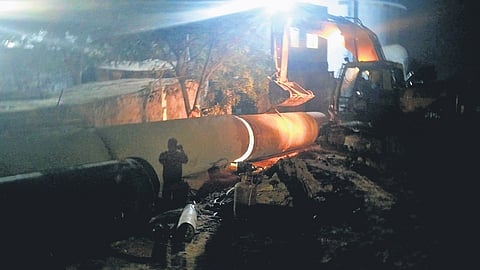

HYDERABAD: Trial runs of the newly completed pipeline interconnections at Ghanpur reservoir are scheduled to begin on Thursday or Friday and continue for four to five days, as the Hyderabad Metropolitan Water Supply and Sewerage Board (HMWSSB) prepares to draw an additional 40 million gallons per day (MGD) of Godavari water into the city’s supply network.
The Water Board has taken up the connectivity works at Ghanpur on a war footing to augment Hyderabad’s drinking water supply ahead of summer. Once the trial runs are completed successfully, the additional water will be diverted to the city, providing an alternative source as storage levels in the Singur and Manjira reservoirs decline.
Under Mission Bhagiratha, Godavari water is supplied from Mallannasagar to Ghanpur reservoir. The Water Board plans to utilise the existing inlet and outlet pipeline infrastructure at Ghanpur to channel the additional 40 MGD into the city’s distribution network. The arrangement is expected to reduce Hyderabad’s dependence on the Singur-Manjira sources, which are under pressure due to declining storage levels and prevailing El Nino-related conditions.
HMWSSB Managing Director K Ashok Reddy, along with senior officials, is scheduled to inspect the completed interconnection works and review preparations for the trial runs. The exercise will help assess the pipeline connectivity and ensure that the additional water can be integrated into the city’s supply system.
Several areas of Greater Hyderabad depend on the Singur-Manjira water system. With demand expected to rise over the coming months, the Water Board is seeking to augment supplies in advance to prevent any shortfall. The additional 40 MGD is expected to provide a cushion to the city’s drinking water network and help maintain supplies as availability from existing sources dwindles.
