
HYDERABAD: Researchers presented solutions to road construction, maintenance and traffic safety challenges at the inaugural session of the 85th Indian Roads Congress (IRC) in Hyderabad on Thursday, including solar-powered accident alert systems for ghat roads and methods to reduce road construction costs.
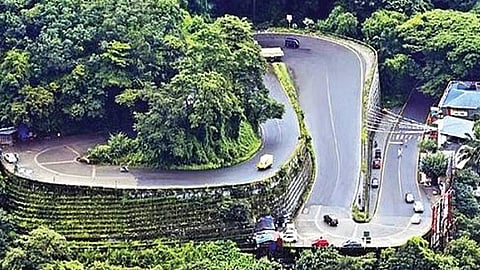
Sudarshan Sampatrao Bobade of Pimpri Chinchwad College of Engineering and Research, Pune, presented proposals to improve safety on ghat roads and ease urban traffic congestion.
One proposal involves installing smart poles at accident-prone locations along ghat roads. Powered by solar panels and wind turbines and equipped with surveillance cameras, the poles would track vehicles travelling between designated points using artificial intelligence-based detection technology.
If a vehicle failed to reach the next monitoring point within the expected time, the system would alert authorities to a possible accident, enabling them to initiate rescue operations.
The system could be particularly useful on ghat stretches with poor mobile network connectivity.
For urban traffic, Bobade proposed redesigning junctions with separate lanes for vehicles travelling straight and heavy and light vehicles taking U-turns, reducing conflicts caused by the larger turning space required by heavy vehicles.
He also proposed multi-level bridges with separate decks for light vehicles, heavy vehicles and local traffic. Restricting the upper deck to light vehicles could reduce structural loads and construction costs by 35-45%, he said.
The proposals would, however, require pilot studies to establish their feasibility.
In another presentation, Dr Suryakant Sahdev of IIT Ropar discussed Full Depth Reclamation (FDR), a road repair technique that reuses existing pavement material instead of replacing the entire road.
The process involves breaking down the existing surface, stabilising the underlying material with cement or other additives, and compacting it for use as a base for a fresh asphalt or concrete layer.
The study was based on field trials at four locations in Himachal Pradesh’s Hamirpur and Bilaspur districts. Researchers examined four sources of reclaimed road material and tested cement dosages of 4%, 4.5% and 5% by dry weight of aggregate.
The quality and performance of reclaimed material varied depending on its source and composition, the study found. Sahdev said particle-size distribution, or gradation, alone was insufficient to determine its suitability for road construction.
Other technical sessions covered pavement design, moisture damage, recycled asphalt, road defect detection, mechanised surface dressing, bridge durability and road foundation compaction.
The technical exhibition at the venue features 401 stalls representing 104 Indian and international companies, showcasing road construction materials, heavy machinery, bridge engineering, road safety systems, pavement testing and sustainable construction technologies.
