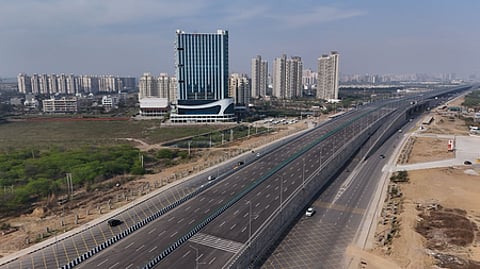

HYDERABAD: Telangana plans to more than double its road capacity from 46,000 lane-km to over one lakh lane-km by 2047, anticipating a nearly three-fold rise in passenger and goods traffic. The State is also looking to rebuild ageing roads to withstand heavier vehicles and growing traffic.
The Roads and Buildings (R&B) department is preparing a master plan aligned with Telangana Rising Vision 2047 and the road sector policy unveiled at the Global Summit. It aims to enable travel from Hyderabad to district headquarters within two hours, between district headquarters within an hour, from district to mandal headquarters within 30 minutes and between mandal headquarters within 15 minutes.
Presenting the plan at the Indian Roads Congress on Saturday, the department said it would move beyond radial and ring roads to develop orbital corridors, factoring in road density, settlement patterns and economic needs. Of the 30 districts outside the CORE region, three district headquarters lack direct National Highway connectivity. Only 206 of the 552 mandal headquarters in the region are connected by National and State highways.
Traffic projections up to 2047 indicate a nearly three-fold rise, increasing pressure on existing roads. The department is assessing travel-time accessibility, traffic patterns and road conditions to identify infrastructure needs.

Meanwhile, the state plans to develop 12,000 km of roads under the Hybrid Annuity Model (HAM). Government Chief Engineer (Roads) B Venkateshwar Rao told TNIE that 6,000 km had been sanctioned in the first phase for `13,000 crore, with the second phase expected three to four months after work begins on the first.
He said existing roads, designed for around 10-tonne loads, were now carrying vehicles weighing 40 to 50 tonnes. “Traffic has increased four to five times in the last 10 years. Apart from the increase in traffic, the weight of vehicles has also gone up, with six-axle commercial vehicles now carrying 40 to 50 tonnes,” he said.
The proposed one-metre pavement comprises a 500-mm subgrade, 250-mm granular sub-base, 200-mm wet mix macadam and 100-mm bituminous concrete, designed to withstand 40 to 50 tonnes.