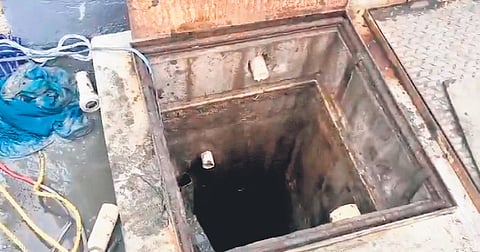

HYDERABAD: The scourge of manual scavenging despite being banned by the Supreme Court reared its ugly head again on Tuesday, this time claiming the lives of three sanitation workers who died after allegedly inhaling poisonous gas while cleaning a septic tank at an apartment complex in Bachupally.
Following the deaths, police registered a case of culpable homicide not amounting to murder against Ravi, owner of the company that employed them, on charges of failing to provide safety equipment and ensure proper supervision.
The victims were identified as K Shanmukha Rao alias Suman (26) and Suresh Gajiki (24) from Makuvaram village in Kothur mandal, and Y Pavan (20) from Yalapeta village in Kota Bommali mandal, all in Srikakulam district.
According to a complaint lodged by Suresh’s relative, Tolugu Bala Sai, the 24-year-old told him that someone had visited his house and offered him a job. The two then went to Dinesh Auric Apartment, where Suman was cleaning the septic tank.
Bala Sai told police that he was standing nearby when Suman suddenly lost consciousness. Pavan, who was working alongside him, entered the tank but also became unresponsive.
Suresh then went inside to check on them but neither returned nor responded.
When Bala Sai called out to the three workers without receiving a response, he telephoned his elder brother Yesu. Two apartment residents were also near the septic tank, he added in his complaint.
Bala Sai said he learnt that Suman and Pavan worked as Sewage Treatment Plant (STP) operators for HR Enviro Protection System and that Suresh had been brought there with the promise of a job.
He alleged that no company support staff was present and the workers had not been provided with safety equipment.
He further alleged that Ravi had sent the three workers into the tank without safety precautions or supervision, causing them to inhale poisonous gases, lose consciousness and die.
‘Incident exposed serious gaps in safety laws’
Based on the complaint, Bachupally police registered a case against Ravi under Section 105 of the Bharatiya Nyaya Sanhita (BNS).
The Prohibition of Employment as Manual Scavengers and their Rehabilitation Act, 2013, prohibits employing people to clean sewers and septic tanks without prescribed protective equipment and safety measures.
Police have invoked Section 105 of the Bharatiya Nyaya Sanhita (BNS), which deals with culpable homicide not amounting to murder, in this case.
In its judgment in Dr Balram Singh vs Union of India on October 20, 2023, the Supreme Court enhanced compensation for families of those who die during hazardous sewer and septic tank cleaning to
Rs 30 lakh. Lok Sabha data show that nine sanitation workers died during such cleaning between January 1, 2021 and June 30, 2026.
A senior official of the National Commission for Safai Karamcharis told TNIE that the Bachupally incident exposed serious gaps in the implementation of safety laws and regulation of informal sanitation workers and cleaning agencies.
The Commission has contacted the authorities concerned and will issue a written notice seeking an initial report. It will examine the findings before deciding on further action, including responsibility for compensation, the official said.
He said state and local authorities were responsible for enforcing the law through district administrations, municipal corporations and other departments. Their failure to regulate the sector left workers exposed to hazardous conditions.
“The apartment management appeared to have engaged a local cleaning agency instead of approaching the Hyderabad Metropolitan Water Supply and Sewerage Board (HMWSSB) for the work. Local cleaning workers and agencies operating in the unorganised sector often lack safety equipment and the necessary arrangements to undertake hazardous cleaning,” he said.
He called for a mechanism to identify workers and cleaning agencies, maintain records, provide training and ensure access to protective gear. The HMWSSB and municipal authorities should maintain databases of sanitation workers and informal cleaning groups in their jurisdictions, he said.
“There should be boards and toll-free numbers at prominent places so that people know whom to contact for septic tank cleaning. The local workers and groups engaged in this work should be identified, registered and brought under the supervision of the authorities. Whenever they receive a cleaning assignment, they should inform the department concerned and obtain the required safety equipment,” he said.
The largely unorganised sector leaves workers vulnerable to poisonous gases in confined spaces, often without oxygen cylinders, protective equipment or standard operating procedures, he added.
He stressed the need to organise and train workers rather than deprive them of their livelihoods. Government departments should identify those dependent on such work and help them find safer employment.
“Workers cannot simply be asked to stop doing this work without providing them with alternative livelihood opportunities. They need to be organised, trained and equipped. They can also be supported with small machines and other resources to make their work safer,” he said.
The official said residents should use authorised channels for septic tank cleaning instead of hiring unregulated workers. Private agencies with appropriate machinery, trained personnel and safety arrangements could also undertake the work, provided they followed prescribed procedures.
When contacted, HMWSSB Managing Director K Ashok Reddy told TNIE that the Board had no role in the incident as the septic tank belonged to a private apartment.
