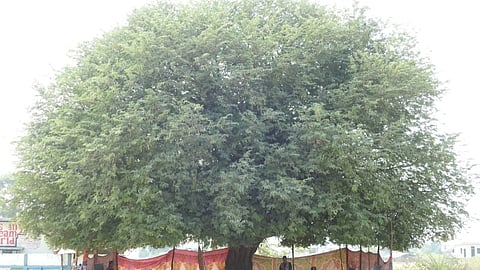

ADILABAD: No classroom, no problem. At Akkapelligudem’s Mandal Parishad Primary School (MPPS) in Jannaram mandal, two sections of students attend classes under trees covered with tents. Yet, parents from 12 gram panchayats send their children there in autorickshaws and bear the transport costs, convinced that headmaster J Srinivas can give them a quality education.
The school, which offers English-medium education from classes 1 to 5, has seen its enrolment soar from just 18 students in June 2024, when Srinivas took charge, to 483 this year. Each class now has two sections, making it the first primary school in the mandal to achieve such an enrolment.
The growing strength, however, has outstripped the school’s infrastructure. Designed to accommodate barely 200 students, the school has had to make room for additional sections under trees, with tents providing some protection from the elements.
The enrolment rose to 252 by the end of 2024, increased to 354 in 2025 and touched 483 in 2026. Despite the shortage of classrooms, the school has earned a reputation for combining modern teaching methods with individual attention to students.
It is also among the first government primary schools in the area to offer facilities such as computers, air-conditioned classrooms and CCTV cameras in every classroom. Several students have secured admission to Jawahar Navodaya Vidyalayas and Gurukulam and Model schools.
The school’s appeal extends well beyond Akkapelligudem. Although government schools are available in the surrounding 12 gram panchayats, many parents prefer to send their children to this institution, even paying for daily auto transport.
For Ankam Mahesh and Ulvakhani Mallesh of Kishtapur village, about 6 km away, the lack of classrooms is not a deterrent. They said their children attended classes under trees but what mattered to them was the quality of education.
“We want our children to get a good education. Where they sit is not our concern. We are willing to send them by auto as long as they learn,” they said.
K Tirupathi, who sends his children from TG Palli village, about 7 km away, said the school offered good education through modern teaching methods. He recalled that Srinivas had personally visited their village and the students’ homes to gather information about families and encourage parents to enrol their children.
That personal outreach, according to Srinivas, is central to the school’s growth. He said he visited the homes of all 483 students three times during the academic year, between August and March, following a weekly schedule.
The visits help him understand each family’s financial circumstances, the child’s learning environment and the difficulties students face in individual subjects. This also gives parents an opportunity to raise concerns directly, which the teachers then try to address at school.
The school also organises three parent meetings every year — before the Dasara and Sankranti holidays and on the annual day — to discuss students’ progress and address concerns.
Srinivas told TNIE that parents had remained supportive despite their children having to attend some classes under trees. Former students who are now settled in different parts of India and abroad have also extended support through a foundation to help the children with their education.
The school currently has seven regular teachers and six Vidya Volunteers (VVs).
Srinivas, who has previously worked at Ponkal and Deviniguda schools, said he had also helped increase enrolment at those institutions. At Ponkal, the strength rose from 42 to 152, while Deviniguda recorded an enrolment of 150 students.
Meanwhile, although the state government sanctioned a model school for the village, but work on the project is yet to begi. For now, students continue to learn under makeshift tents, while the growing enrolment underscores the urgent need for additional classrooms.
