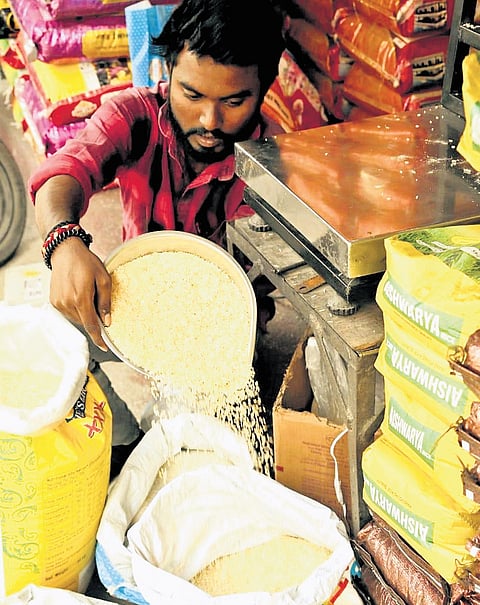

HYDERABAD/NIZAMABAD/NALGONDA: A sharp rise in rice prices is beginning to pinch household budgets across Telangana. Fine rice, a staple in homes across the state, is now selling at Rs 80-82 a kg, up from Rs 70 earlier. A 25-kg bag is now being sold at Rs 2,150, up from around Rs 1,800.
However, rice is not the only item getting costlier. Between September and October, toor dal rose from Rs 126 to Rs 143 a kg, urad dal from Rs 120 to Rs 128, moong dal from Rs 106 to Rs 112 and gram dal from Rs 80 to Rs 90. Gundu chilli climbed from Rs 330 to Rs 420 a kg, long chilli from Rs 275 to Rs 290 and coriander from Rs 190 to Rs 210. Basmati rice rose from Rs 113 to Rs 122 a kg, sugar from Rs 43 to Rs 50, almonds from Rs 1,000 to Rs 1,150, raisins from Rs 320 to Rs 420, split cashews from Rs 760 to Rs 830 and whole cashews from Rs 760 to Rs 850 a kg.
Behind the rise in rice prices is a tightening supply situation, linked partly to the decline in rice acreage during the current Kharif season. Nationally, the area under rice cultivation fell from 449.18 lakh hectares in 2025-26 to 433.62 lakh hectares this year, a decline of 3.46%, according to the Ministry of Agriculture and Farmers Welfare.
The reduction in acreage came after the India Meteorological Department forecast a below-normal monsoon in May, factoring in the possible influence of El Nino. The southwest monsoon has since been uneven, with 18 of the 36 meteorological subdivisions, accounting for 53% of the country’s area, receiving normal rainfall, while 17 subdivisions covering 42% recorded deficient rainfall.
Miryalguda Rice Miller Association president Gauru Srinivas said premium rice stocks were under strain, with poor rainfall and lower yields affecting availability. HMT was selling at around Rs 7,600 a quintal, PPT at Rs 6,500 and R&R at Rs 7,200.
“The stock is not sufficient. There is no rain and the yield is low. The premium quality is only around 50%,” he added.
The rise is even steeper when it comes to paddy. A miller in Miryalguda said the open-market price of a quintal of paddy had risen to Rs 4,000 from Rs 3,400 just 10 days earlier, against a Minimum Support Price (MSP) of Rs 2,440.
Supply constraints are also being felt in Nalgonda. Of the district’s total 11.23 lakh acres of farmland, crops were planted in 9.92 lakh acres during the Kharif season.

Millers paying more than MSP to buy rice from farmers
Fine rice was grown on 1.79 lakh acres and coarse rice on 2.4 lakh acres, with the rest used for cotton and pulses. Agriculture officials expect 10.51 lakh metric tonnes of paddy production, but civil supplies officers estimate only 4.5 lakh metric tonnes will reach government buying centres.
The uncertainty over future supplies is also prompting millers and traders to buy early. Fearing that El Nino may last until July 2027 and cause a crop holiday in future seasons, they are buying raw fine paddy. Miller R Ganesh from Miryalaguda said they were paying Rs 4,050 per quintal directly to farmers. A farmer from Nalgonda said the government offers Rs 2,461 as the base price plus a Rs 500 bonus, but millers are paying much more, naturally pushing up market rice prices.
Nalgonda Millers Association leader B Narayana said mills normally receive around 10 lakh tonnes of paddy, but El Nino could reduce this to three to four lakh tonnes. With each mill employing 50-60 workers, millers are buying paddy at higher rates to keep operations running.
The price rise is also changing the way farmers sell their paddy. V Gurunatham from Kesharajapalli said that, unlike last season, millers are now visiting farms directly, paying advance money before harvest and taking care of transport costs themselves. Earlier, farmers waited for days at buying centres with rented tractors and faced price deductions for moisture and waste.
Kharif rice cultivation begins in the first week of June, with harvesting around October-November. Before the new crop reaches markets in large quantities, millers and traders track acreage, crop conditions and expected production and bid according to anticipated availability.
The rise has also been uneven across varieties. Fine and premium rice have seen the sharpest increase due to strong demand, particularly in southern India, where they are widely used for ration-card supplies. Coarse rice has remained relatively stable at around Rs 40-45 a kg, with no similar disruption in arrivals.
Concerns over future supplies are also extending to the upcoming Rabi season. Traders said the impact of El Nino and lower paddy cultivation in Andhra Pradesh, Karnataka and Tamil Nadu had raised concerns over future supplies. Telangana, however, recorded normal paddy cultivation during the Kharif season. Some traders have responded by maintaining stocks as a precaution, while wholesale movement of rice has remained relatively limited.
In Nizamabad, rice millers said the government had substantial rice stocks in godowns and mills. Nizamabad District Rice Mills Association president Moturi Dayanand Gupta and organising secretary V Mohan Reddy said the government had procured paddy at remunerative prices, while traders from other states were buying directly from farmers at Rs 3,400-Rs 3,900 per quintal. They attributed the rise to supply constraints and El Nino concerns, but said prices had not risen abnormally and could ease to around Rs 35 a kg once government stocks are released.
In Nalgonda, a civil supplies officer said 75,000 MT of coarse paddy was stored in 17 government warehouses. Some farmers were holding back grain in anticipation of higher prices. The official warned of action against illegal hoarding, but said the government could not control open-market retail prices. The price volatility is also affecting trade. In Hyderabad, traders have been avoiding bulk rice purchases amid sharp fluctuations in essential commodity prices and fears of rice weevil. In Nizamabad, consumers have urged the government to check prices, with fine rice selling above Rs 80 a kg in several shops and the price of a 25-kg bag also rising.
The rise comes as Telangana is already facing elevated retail inflation. The state recorded the highest retail inflation among states for the seventh consecutive month in July, at 6.32%. Although it eased marginally from 6.36% in June, it remained above the all-India average of 4.45%.
Economist B Sudhakar Reddy, director, ICSSR-SRC and Dean, Faculty of Social Sciences, Osmania University, said Telangana’s inflation was no longer being driven by one or two commodities alone, with price pressures visible across food, transport, housing, healthcare and services.
Experts have also pointed to changes in the Consumer Price Index following the rebasing of the CPI series. Under the new series, the weight assigned to food and beverages has fallen from more than 42% to 37%, while housing, transport, personal care and services have received greater weight.
B Sudhakar said rainfall during the sowing period remained critical for food prices, as poor rainfall could lead farmers to reduce acreage, lowering production and tightening supplies. “Kharif crops such as rice, pulses and oilseeds are sown between June and August. If rainfall is poor during this crucial sowing period, farmers reduce acreage, resulting in lower production and tighter supplies,” he said.
The economist also said temperature was becoming equally important, as heat stress affected vegetables, dairy production and supply chains even when rainfall remained near normal. For now, the outlook depends on the arrival of the new Kharif crop. Venkataramana Chowdhury, general secretary of the Miryalguda Rice Millers Association, said rice prices had reached their peak and wholesale arrivals were yet to begin in a big way. If arrivals were normal, he said, prices would remain at the current level.
B Sudhakar said a substantial fall was unlikely. Strong arrivals could ease or stabilise fine-rice prices, but weak production and arrivals could keep premium rice prices elevated.