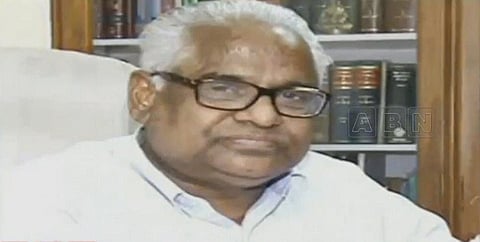

HYDERABAD: Former advocate-general of Telangana and senior advocate K Ramakrishna Reddy has said that the proposed meeting of Congress president Mallikarjun Kharge and Leader of Opposition Rahul Gandhi with Chief Justice of India (CJI) Surya Kant on Monday to raise concerns over alleged irregularities in the Special Intensive Revision (SIR) of electoral rolls would have set a bad precedent.
Reacting to the Congress leaders’ request for an appointment with the CJI, he questioned the propriety of political parties approaching the head of the judiciary through such meetings, particularly when related matters were pending before the Supreme Court.
Speaking to TNIE before the CJI declined to meet the Congress leaders, he said: “The courts are adjudicatory bodies functioning within the parameters of the law and the Constitution. They are not administrative authorities meant to receive memoranda from political parties on issues concerning the administration.”
Ramakrishna Reddy said he was unaware of any specific constitutional provision allowing political parties to meet the CJI to submit representations of this nature, adding that such a practice had not occurred in the past. He argued that meetings of this kind did not form part of the prescribed functions of the CJI or the Supreme Court.
He stated that when a matter was pending adjudication before the Supreme Court, the parties concerned should pursue the remedies available through judicial proceedings. He added that the Supreme Court could, in appropriate circumstances, consider a letter or representation and take action, including treating it as a public interest litigation, if warranted. However, he maintained that an official meeting between the CJI and a political party to raise such concerns was unusual and could set an undesirable precedent.
“Political parties can approach the Supreme Court by filing writ petitions to raise any issues affecting the citizens in breach of the laws and to decide the same in accordance with law,” he said.
The legal issue regarding voter additions, deletions, and alleged illegalities in Forms 6 and 7 under the RP Act is currently pending before the CJI-led bench. The date has already been fixed for appropriate decision. The meeting of political parties with CJI is unprecedented, he further said.
