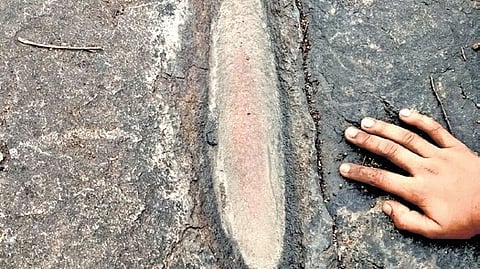

HYDERABAD: Four rock grooves of possible prehistoric significance have been identified near the Banda Juvvi watch tower in Mrugavani National Park at Chilkur, raising the possibility of early human activity in the forested areas around Hyderabad.
The grooves were identified by historian Satyanarayana Dyavanapalli following information provided by B Anand Kumar, administrative officer in the Forest department in Rangareddy district. He has urged the Department of Archaeology and Museums to conduct a systematic survey of the site to establish their origin, purpose and age.
Dyavanapalli told TNIE that the four grooves, each about a foot long and two to four inches deep, are located on a plateau-like rock surface overlooking valleys.
“They may have been used repeatedly to grind or sharpen stone implements, including axes. Their possible association with Neolithic-period activities, dating to around the fifth millennium BCE, remains a hypothesis that requires scientific verification,” he said.
The possible prehistoric origin of the grooves is also being considered in light of the red pigment visible along their surfaces, the historian said.
“During the Neolithic period, stone tools were sharpened using basalt rocks, and the grinding process could have left behind a red residue. The grooves are found on granite rock, and the presence of the pigment could offer a clue to their possible use, though scientific examination is needed to establish its origin,” Dyavanapalli added.

Ancient grooves & rock art may hold clues to our past
He also pointed to two early settlements in the vicinity of the grooves as possible evidence of prehistoric human activity in the area. Their proximity to the rock formations could help researchers investigate whether the grooves were associated with tool-making activities by people who inhabited the region. Further archaeological study is required to establish the relationship between the settlements and the grooves.
Another site bearing ochre-coloured rock paintings is located about a kilometre away, near the Forest Trek Park. The paintings, found on a rock formation resembling a snake’s hood, reportedly depict a turtle, an animal interpreted as domesticated, hunting scenes, arrows and border patterns. One motif has also been tentatively interpreted as representing a fifth phratry, or social subdivision of a group.
The age and significance of the paintings, as well as their possible connection with the grooves, are yet to be established. A detailed archaeological investigation could help determine whether the two locations provide evidence of prehistoric human activity in the region.
The historian has called for the documentation of the grooves and paintings, along with an examination of nearby rock shelters, boulder formations and the surrounding terrain for associated evidence, such as stone tools, pottery fragments and other traces of human activity.
He said the Department of Archaeology and Museums should coordinate with the Forest department to facilitate the investigation and protect the sites within the national park. Scientific documentation and conservation would help establish their archaeological significance and preserve them for future research.