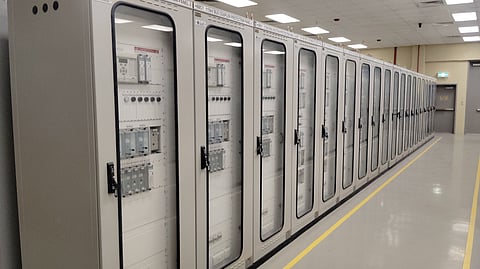

HYDERABAD: Data centres are classified as business occupancies, but their fire risks differ from conventional buildings due to continuously energised equipment, UPS systems, batteries, combustible cable insulation and fuel storage. The Fire department’s new guidelines, issued on Wednesday, seek to address these hazards.
The guidelines prescribe special fire and life safety norms for data centres across the state, limiting basements to two levels. They will apply to applications for provisional Fire No Objection Certificates (NOCs) submitted on or after November 6.
An official said some companies were suspected of planning data centres under mixed-occupancy arrangements.
Data centres house servers, storage systems, networking equipment and associated infrastructure to process, store and transmit electronic data. Operating round the clock, they rely on uninterrupted power, cooling and communication systems, supported by transformers, UPS systems, batteries, generators and extensive cable networks.
Until now, fire safety requirements were assessed under norms for general business occupancy buildings. However, applicants had represented that some requirements were impractical given the specialised design and operational needs of data centres.
The new circular prescribes specific requirements for processing provisional Fire NOC applications. Basements may be used for purposes other than parking only in accordance with specific government orders.
Applicants must obtain a comprehensive fire risk assessment from a competent fire-protection professional, covering data halls, electrical installations, UPS and energy-storage systems, transformers, fuel storage, cable spaces, raised-floor areas and other fire hazards.
The guidelines mandate fire detection and alarm systems, suitable suppression systems, compartmentation, firefighting shafts, wet risers, refuge areas and adequate firefighting water storage and pumping facilities. Sprinklers are prescribed for administrative areas, while technical areas require water-mist or clean-agent gas suppression systems.
The prescribed occupant load is 10 persons for administrative areas and 50 for technical areas, including data halls and server rooms. Fire compartments must be provided for every 2,000 square metres of floor area.
Each building must have a 10-square-metre refuge area at a height of 15 metres, with an additional 10-square-metre area for every subsequent 10 metres of height.
One fire tower is required for each fire compartment. Buildings with three or more compartments must have at least two fire towers. One wet riser must be provided for every 1,000 square metres of floor area.
Data centres must have an underground firefighting water tank with a capacity of 2 lakh litres and a terrace tank holding 20,000 litres. The underground pump room must house electric and diesel firefighting pumps, each with a capacity of 2,280 litres per minute (LPM), and a jockey pump rated at 180 LPM.
