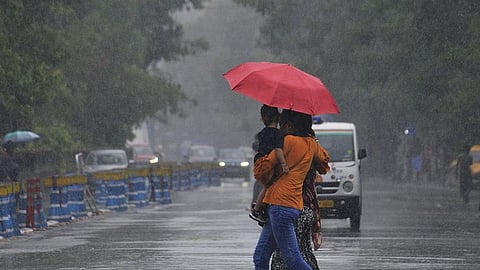

HYDERABAD: Telangana could see a significant increase in Southwest Monsoon rainfall during the 21st century, with climate projections pointing to wetter monsoons, more heavy rainfall events and greater year-to-year variability, according to a study based on bias-corrected CMIP6 climate simulations.
The study, “Consistent Increase in Southwest Monsoon Rainfall in Telangana, India: Insights from Bias-Corrected CMIP6 Simulations,” examined future rainfall patterns across the state using climate models corrected against India Meteorological Department (IMD) rainfall observations.
Researchers found broad agreement among multiple climate models that monsoon rainfall over Telangana is likely to increase under both intermediate- and high-emissions scenarios. Raw Global Climate Models often contain systematic biases when applied to regional climates. To improve the reliability of projections, the researchers used quantile-mapping bias correction against observed IMD rainfall data. After correction, the models consistently projected an upward trend in June-September rainfall over Telangana throughout the century.
The increase is expected across near-, mid- and end-century periods, suggesting that Telangana’s monsoon climate could gradually become wetter than historical averages. The projections indicate a sustained shift rather than a short-term change in the state’s Southwest Monsoon rainfall regime.
A key finding is that the rise in seasonal rainfall could be accompanied by more intense rainfall episodes, rather than simply an increase in the number of rainy days. Global warming and an intensified hydrological cycle are expected to contribute to more frequent heavy rainfall days and extreme precipitation events.
Rainfall could also become more concentrated over shorter periods, increasing the risk of intense downpours, flash floods and urban flooding.
The study also projects greater interannual variability, meaning Telangana could see wider swings between wetter and relatively drier monsoon years. While the long-term trend points to higher rainfall, individual years could continue to vary considerably, posing challenges for agriculture, water management and disaster preparedness.
The projected changes have significant implications for Telangana’s agriculture, which depends heavily on the Southwest Monsoon. Higher overall rainfall could improve water availability and reservoir inflows, but intense spells over short periods could also cause waterlogging, crop damage and soil erosion.
Heavier rainfall events could put additional pressure on irrigation and drainage infrastructure. Reservoir and water-resource management systems may need to prepare for larger and faster inflows during extreme rainfall events.
The findings underscore the need for stronger climate-resilient planning in Telangana. Improved flood forecasting and early-warning systems, better urban drainage, more responsive reservoir operations and climate-resilient farming practices could become increasingly important as rainfall patterns change.
