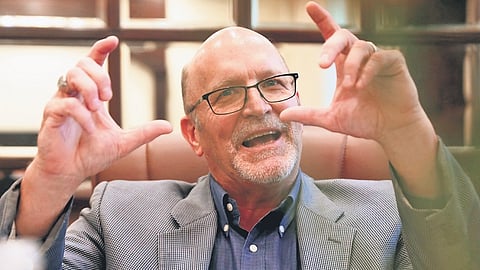

HYDERABAD: Telangana needs early talent identification, elite coaching and strong athlete support to produce more Olympic medallists, said Kevin Lennon, former senior vice-president of policy and governance at the National Collegiate Athletic Association (NCAA), in an interaction with TNIE’s Siddhardha Gattimi during his visit to Hyderabad as part of a US sports diplomacy initiative.
Telangana wants to strengthen its sports ecosystem and produce more Olympic medallists. What should it focus on?
The biggest thing is building a culture around sport. Telangana clearly wants to win more Olympic medals and produce elite athletes, but that requires looking at the entire ecosystem.
For elite athletes, three things are critical: early talent identification, the best possible coaching and strong support. Identify talent early, give athletes opportunities to compete against the best and provide quality coaching, medical care and facilities to help them reach their potential.
The US is one example, where much elite development happens through colleges, but higher education need not be the only route. What matters is creating multiple pathways. An athlete with Olympic potential may need a non-traditional academic route, such as homeschooling or a specialised school, to balance studies with high-level training.
At the college level, a strength of the US model is its broad-based approach to sport. The NCAA encourages institutions to offer a wide range of sports, creating opportunities for young athletes, including those pursuing Olympic disciplines.
What can Telangana learn from the US collegiate model without simply copying it?
Pick what works rather than trying to bring the entire American system here. The US model has significant challenges of its own.
The growth of name, image and likeness (NIL) payments, for example, has brought enormous amounts of money into college sport. Schools can provide up to USD 22.5 million in NIL-related payments, in addition to scholarships, while boosters can pay athletes for commercial opportunities. That has created a growing divide between institutions with money and those without it.
NCAA Division 1 and Division 2 institutions provide athletic scholarships, while Division 3 follows a non-scholarship model. Depending on the institution and sport, scholarships can cover tuition, fees, books, room and board.
Beyond elite sport, how important is youth participation?
Extremely important. You need both — elite development and broad youth participation. Around 60% of American children aged six participate in sport, while the figure for India is in the single digits for formal sports programmes. That difference can have a lifetime effect.
Sport is not just about playing. It can also create workforce and economic opportunities. A young person interested in sport can find careers in event management, coaching, technology, artificial intelligence, fan engagement and sports associations. That is how you build a broader sporting culture.
What should Telangana and India take away from your visit?
The US and India are at different stages of development, but that is not a criticism. India can learn from systems around the world, including the US, without copying them. It can take the best ideas and create its own version.
There is also an opportunity for the US to learn from India. I am particularly interested in the innovation happening here and in institutions willing to approach sports differently.
I am excited to see what Telangana does with this opportunity, particularly with the new university. It does not have to follow a 60-year journey. It can take the best of what already exists around the world and build something uniquely its own.
