
KARIMNAGAR: Between the villages of Peddakalvala and Chinnakalvala lies a temple that holds clues to Telangana’s ancient iron industry. Dedicated to Mammai Devi, the deity of the Vishwakarma community, the temple houses stone sculptures believed to date to the 16th or 17th century and stands in a region with traces of a once-thriving iron trade.
The villages are also located close to Peddabonkur, an important Satavahana settlement.
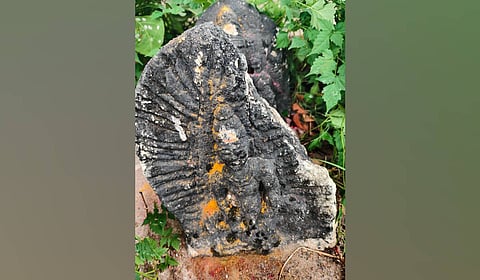
The Mammai temple houses a stone sculpture of the goddess worshipped by the Vishwakarma community. Based on its sculptural style, the idol is believed to belong to the post-Kakatiya period, possibly the 16th or 17th century CE. A modern idol resembling the sculpture has also been installed beside it.
According to researcher Karipe Raj Kumar, currently deputy director in the Audit department, the goddess is depicted seated, with Nandi and a Shiva Lingam carved on the upper right and the sun and moon on the upper left. Lord Ganesha and Hanuman are depicted in the middle portion.
Three severed heads are shown beneath the goddess’s feet, with camels and serpent figures on either side. The four-armed deity holds weapons in her upper hands, while the lower right hand is in Abhaya Mudra, symbolising protection and fearlessness.
The temple premises also contain another Mammai idol believed to belong to the Kakatiya period.
Raj Kumar says that during the Kakatiya period, new villages were established with the assistance of 12 traditional functionaries. Five occupational communities associated with the Vishwakarma tradition were considered particularly important — blacksmiths, carpenters, brass and metal workers, sculptors and goldsmiths. Together, they are regarded as the five faces, or Panchananams, of Vishwakarma, with Mammai Devi considered their traditional deity.

The Peddakalvala temple comprises a sanctum sanctorum, a mukha mandapa supported by 16 pillars and an entrance mandapa. Annual festivities are held for a week from Ugadi, when members of the Vishwakarma community place their traditional tools and implements before the deity and perform special prayers.
Mammai temples are predominantly found in regions where iron and steel industries flourished in ancient times. Historical evidence suggests that iron produced in these regions was exported abroad, pointing to a possible link between Mammai worship, Vishwakarma occupational traditions and the region’s iron industry, the researcher adds.