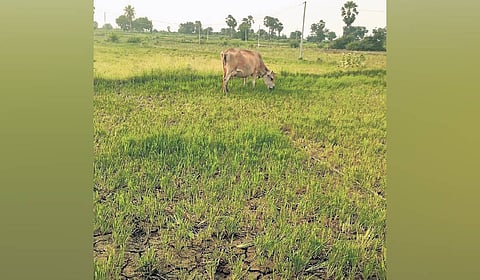

HYDERABAD: P Narsi Reddy had five acres of paddy ready for harvest, but with the rains failing and no assured water source, he has now left the crop for his cattle to graze. The 66-year-old farmer has also abandoned a four-acre plot prepared for vegetable cultivation and expects his one-acre cotton crop to yield just one quintal, against the normal 10 to 11 quintals.
He rues that farmers had not taken seriously the Agriculture department’s warning against cultivating paddy without an assured water source. “With the weather department failing to predict rains accurately, farmers did not take the warnings as seriously as they should have. We did not expect things to be this bad,” he says.
Narsi Reddy says middle-class farmers have been among the worst affected. His bank loans have now risen to Rs 8 lakh. He did not benefit from either of the loan-waiver schemes, with the BRS government’s waiver capped at Rs 1 lakh and the Congress government’s limit at Rs 2 lakh.
Duggi Krishna, 50, of Maddipalli village in Kamepalli mandal of Khammam district, has sown cotton on three acres and says the crop is drying up. The plants are at the pod stage and recent drizzle has provided some temporary relief. He says he obtained seeds and other inputs from private dealers under informal arrangements and will have to sell the produce to them despite higher market prices.
Another farmer, Vajja Rama Rao of Gadepadu mandal in Khammam district, says farmers were advised to take up rain-fed crops but were not provided seeds.
23% rainfall deficit
The situation comes against a 23% rainfall deficit in 19 of Telangana’s 33 districts. Of these, 15 have recorded deficits of more than 30%. The state received only 11.20 mm of rain last week against the normal 42.20 mm, a deficit of 73%.
Agriculture department data shows that Telangana received 485.9 mm of rainfall between June 1 and September 9 this year, against the normal 629.4 mm and 768.9 mm during the corresponding period last year. The total area sown is 123.08 lakh acres, or 93% of the normal 132.38 lakh acres.
Paddy acreage stands at 54.26 lakh acres against a normal 65.96 lakh acres, while cotton has been sown on 48.24 lakh acres against a normal 47.42 lakh acres. Maize acreage is 5.93 lakh acres against the normal 6.17 lakh acres.
Water storage in reservoirs covered by the data for Telangana and Andhra Pradesh has also fallen from 886 tmcft to 507 tmcft.
Dr A Sravani, scientist at the IMD, Hyderabad, says isolated thunderstorm activity is expected over the next two weeks, but the southwest monsoon is likely to begin withdrawing from September 18.
“Heavy rain will depend on the formation of systems in the Bay of Bengal. There is less chance of their formation, so there could be moderate rain,” she says.
Kiran Vissa of Rythu Swarajya Vedika says even late September rain will not prevent many districts from ending the monsoon season in the deficit category and warns of high yield losses. Tenant farmers, he says, are particularly vulnerable as they have already paid land rent.
Kiran Vissa calls for drought to be declared in deficit mandals, prompt assessment of crop losses and Rs 10,000 per acre in assistance to farmers suffering at least 33% yield loss.
He also seeks the release of pending compensation for earlier crop damage caused by natural disasters, besides fodder and water for cattle and rescheduling of crop loans.
Dr G Rajasekhar of the Centre for Sustainable Agriculture suggests distributing horse gram, green gram, black gram and sesame seeds. Horse gram, he says, costs about Rs 200 per kg, with four kg sufficient for an acre, while also providing fodder.
The Telangana Farmers and Farmers Welfare Commission has alerted the government about the situation, chairman M Kodanda Reddy says.
A Cabinet sub-committee has made suggestions on seed availability, crop diversification, water management and horticulture.
The Telangana Assembly is scheduled to discuss the “Effects of El Nino — Remedial Measures” on September 16.
