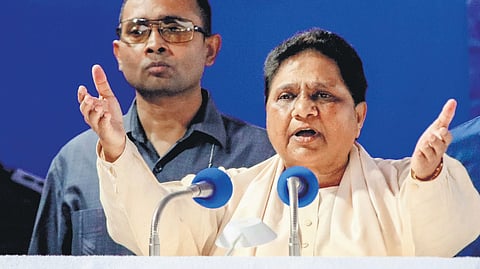

The death of Bahujan Samaj Party's (BSP) lone Uttar Pradesh MLA, Umashankar Singh, has left Mayawati's party without a single representative in the 403-member Uttar Pradesh Assembly, marking yet another milestone in the BSP's dramatic political decline from ruling the state with an absolute majority in 2007 to having no legislative voice today.
The three-time MLA from Ballia's Rasra constituency died on Wednesday night at a Delhi hospital after a prolonged battle with a brain tumour. He was 55.
His death comes at a crucial juncture, with Uttar Pradesh heading towards the 2027 Assembly elections. While the Election Commission is yet to announce whether a bypoll will be held for the vacant Rasra seat, Singh's demise has, for now, deprived the BSP of its only voice inside the Assembly.
Calling his death an "irreparable loss", BSP president Mayawati paid an emotional tribute to one of her closest political confidants.
"The demise of BSP's dedicated and popular MLA from Rasra, Shri Umashankar Singh, after a prolonged illness is extremely sad and an irreparable loss for the party. My heartfelt condolences to his family and supporters," she posted on X.
Mayawati also spoke to Singh's family and urged his son not to lose courage, assuring them that the BSP stood firmly with them in this difficult time.
Singh shared a close personal bond with the BSP chief, who was known to tie Rakhi to him every year.
Uttar Pradesh Chief Minister Yogi Adityanath also condoled Singh's demise.
"The demise of MLA Shri Umashankar Singh is extremely saddening. I pray for peace to the departed soul and strength to the bereaved family to bear this irreparable loss," the Chief Minister posted on X.
Samajwadi Party president Akhilesh Yadav, Deputy Chief Minister Keshav Prasad Maurya, Congress leaders and several legislators across party lines also expressed grief, recalling Singh's long public life and contribution to politics.
From 206 MLAs to None
Singh's death is far more than the loss of an experienced legislator. It also brings to an end the BSP's legislative presence in Uttar Pradesh.
The development also amounts to the party's remarkable decline. In 2007, Mayawati scripted history by leading the BSP to power with 206 seats. Five years later, the party lost power to the Samajwadi Party. The BJP wave of 2017 reduced the BSP to just 19 MLAs, while the 2022 Assembly election saw the party crash to only one seat—Rasra—where Umashankar Singh retained the constituency despite the BSP's statewide collapse.
With his death, the BSP no longer has an elected representative in the Uttar Pradesh Assembly. For the first time in decades, Mayawati's party will have no one to raise public issues, question the government, participate in debates or intervene during legislative proceedings, significantly reducing its political visibility.
A Bigger Organisational Challenge
Political analyst Dr. Shashikant Pandey, Head of the Department of Political Science at Dr. Bhimrao Ambedkar University, Lucknow, believes the impact extends far beyond the loss of one legislator.
"The significance of Umashankar Singh's death is not confined to the loss of one Assembly seat. He was the BSP's only institutional presence inside the Uttar Pradesh Assembly. With his demise, the party has lost its legislative voice, making it even more difficult to remain politically visible until the 2027 elections."
According to Dr. Pandey, Singh's death symbolises the broader decline of a party that once dominated Uttar Pradesh politics.
"The BSP's journey from 206 MLAs in 2007 to none today reflects not just an electoral decline but an organisational crisis. The party still retains a committed core vote base, particularly among sections of Dalits, but it has struggled to convert votes into seats because of changing political equations and the emergence of multiple claimants over its traditional support base."
An Irreversible Loss the
Political observers believe Umashankar Singh's death is an irreversible setback for the BSP not merely because it has lost its only MLA, but because it has lost one of the few leaders who combined organisational loyalty, electoral credibility and Mayawati's complete confidence.
Unlike several senior BSP leaders who either deserted the party or were expelled over the years, Singh remained unwaveringly loyal through its most difficult political phase. His victory from Rasra in 2022 had reassured party workers that the BSP was still capable of winning elections despite its shrinking footprint.
Dr. Pandey says replacing such a leader will be extremely difficult.
"For the BSP, this is an irreversible political loss because leaders like Umashankar Singh cannot be created overnight. He enjoyed Mayawati's complete trust, had deep organisational roots and commanded personal goodwill among voters. The party has lost not just an MLA but one of its last credible political faces."
He said the timing of Singh's death could not have been more challenging, with every major political party aggressively courting the Dalit vote ahead of the 2027 Assembly elections.
"The BSP is entering perhaps its toughest electoral battle. The BJP has systematically expanded its outreach among non-Jatav Dalits through welfare schemes and political representation. The Samajwadi Party is making sustained efforts to consolidate its PDA (Pichhda, Dalit, Alpsankhyak) alliance, while Chandrashekhar Azad is projecting the Azad Samaj Party as a more assertive platform for Dalits, particularly the youth. Every major political player is now competing for the same social constituency that once formed the BSP's unquestioned support base."
Dr. Pandey believes the BSP's biggest challenge is no longer just electoral but existential.
"Mayawati now faces a three-fold challenge. She has to prevent further erosion of the BSP's traditional Dalit vote, rebuild the confidence of party workers and convince a new generation of Dalit voters that the BSP still represents their aspirations. Without a legislative presence and without leaders like Umashankar Singh, that task becomes considerably more difficult."
The Road Ahead
The BSP now faces a defining moment. It must revive its organisation while remaining politically relevant without a single MLA in the Assembly. The party's traditional Dalit vote bank is under sustained pressure from all sides—the BJP's extensive outreach among non-Jatav Dalits, the Samajwadi Party's renewed social coalition under the PDA plank, and the growing appeal of Chandrashekhar Azad among younger Dalit voters.
For Mayawati, the challenge is no longer simply to improve the party's electoral performance in 2027, but to reclaim the political space that the BSP once dominated. Without a legislative platform and after losing one of her most trusted lieutenants, that task has become significantly harder.
For now, Umashankar Singh's death marks more than the end of a political career. It marks the end of the BSP's legislative presence in Uttar Pradesh and serves as a stark reminder of the extraordinary rise and equally dramatic decline of a party that once used to be one of the most powerful parties.
