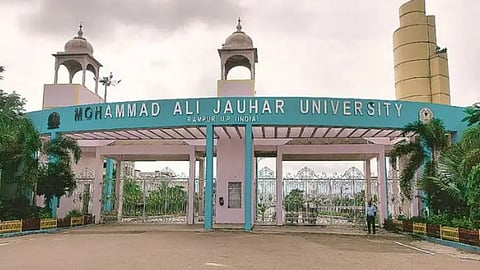

Will bulldozers roll into Azam Khan's dream university? That question has resurfaced after the Rampur Development Authority (RDA) issued a demolition notice for 38 buildings at Mohammad Ali Jauhar University, directing the management to remove the allegedly unauthorised structures within 15 days or face demolition.
The action has once again brought the institution founded by senior Samajwadi Party leader Azam Khan into the spotlight, reigniting both legal and political debates.
Rampur District Magistrate Ajay Kumar Dwivedi said the university management has been asked to remove the unauthorised constructions within the stipulated period, failing which the RDA will demolish the structures and recover the cost from the management.
According to the development authority, the buildings were constructed without obtaining mandatory building plan approvals under the Uttar Pradesh Urban Planning and Development Act. Officials said the demolition order was issued after following the prescribed legal process and taking into consideration the university's response.
Founded by the Mohammad Ali Jauhar Trust in 2006 and granted university status in 2012, Mohammad Ali Jauhar University has remained the centrepiece of Azam Khan's political legacy. Built across a sprawling campus in Rampur, the institution offers courses in medicine, engineering, law, agriculture, education and humanities, besides housing a medical college, hospital, hostels and residential facilities.
Throughout his political career, Azam Khan described the university as his "dream project" and the mission of his life, saying it was created to expand access to higher education, particularly for students from minority and economically weaker backgrounds.
Supporters regard it as one of the largest educational institutions established in western Uttar Pradesh, while critics have long questioned the manner in which land for the campus was acquired and developed.
The latest demolition notice comes against the backdrop of a series of legal disputes involving the university and its founder. Since 2019, Azam Khan, his wife Dr Tazeen Fatima, son Abdullah Azam Khan, and members of the Mohammad Ali Jauhar Trust have faced multiple criminal cases related to alleged illegal land acquisition, encroachment on government property, forgery and misuse of public land.
The Uttar Pradesh government has alleged that land belonging to farmers, government departments and even enemy property was illegally merged into the university campus. It also cancelled leases of certain land parcels allotted to the university, a decision upheld by the Allahabad High Court, while the Supreme Court declined to interfere.
Unlike earlier disputes that largely revolved around land ownership, the current proceedings focus on alleged violations of building regulations. Officials maintain that every institution is required to obtain sanctioned building plans before construction and that the same legal standards are being applied in this case.
The university management can challenge the demolition order before the appropriate court. Until then, the future of the 38 buildings remains uncertain.
The issue also carries political significance. Once among the Samajwadi Party's tallest Muslim leaders and the undisputed political face of Rampur, Azam Khan has seen his influence diminish amid a series of legal battles. The BJP government has maintained that action against illegal encroachments and unauthorised constructions is being carried out uniformly across Uttar Pradesh. The Samajwadi Party, however, has repeatedly alleged that Azam Khan has been selectively targeted through multiple criminal and administrative proceedings, an allegation rejected by the state government.
As of now, academic activities continue on the campus. Whether bulldozers eventually arrive will depend on the university's legal response and the outcome of the court proceedings.
