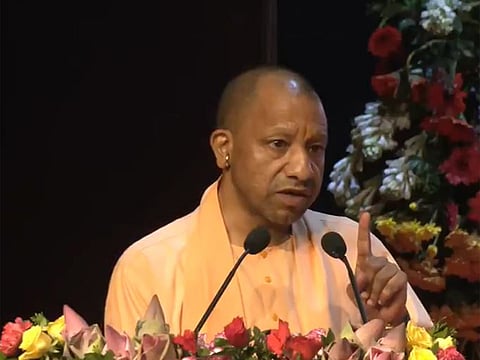

LUCKNOW: Calling UP a reflection of country’s cultural consciousness, spiritual traditions and knowledge heritage besides being a centre of faith, UP CM Yogi Adityanath said that developments related to tourism should not be limited merely to the creation of infrastructure, but should be advanced by linking it with cultural renaissance, local economy, employment generation and global recognition.
While reviewing the work and worth report of the state tourism department on Thursday, Yogi said that the sector had a significant role in giving new momentum to the state’s cultural economy.
“Through tourism development, local products, handicrafts, traditional arts, cuisine, culture and the service sector will also receive extensive opportunities,” he said.
While reviewing Gyan Bharatam Mission related to the preservation of India's knowledge tradition, the Chief Minister stated that ancient manuscripts were invaluable treasures of country’s civilization, philosophy, science and cultural consciousness.
“Their preservation and digitization are not merely archival exercises, but a means of connecting future generations with their roots."
The officers concerned claimed in the meeting that the work of survey, digitization and preservation was done on more than 13.70 lakh manuscripts.
During the review of the proposed amendments to Tourism Policy-2022, the Chief Minister stated that UP should be developed as a leading centre for investment, innovation and experience-based tourism.
The discussions were also held on the development of new areas under Neem Karoli Baba Circuit and the Bundelkhand Fort Circuit. Deliberations were also held on promoting new concepts such as ‘Parampara’ Heritage Experience Centres, Agri Tourism and Vineyard Tourism.
The Chief Minister said that the tourism policy should attract investment, increase employment opportunities and provide unique experiences to tourists. Reviewing the newly inaugurated Naval Shaurya Vatika in Lucknow and the under-construction INS Gomti Shaurya Museum, the Chief Minister said that the project would become an important medium for spreading the message of patriotism, military pride and India's maritime heritage among younger generation.
While reviewing the under-construction Chhatrapati Shivaji Maharaj Museum in Agra, CM Yogi stated that it was the national responsibility to carry the inspiring stories of national heroes to the younger generation. “The museum will present, through modern technology, the life and times of Chhatrapati Shivaji Maharaj, the establishment of Swarajya, his visit to Agra, his indomitable courage in Aurangzeb's court, his historic departure from Agra, coronation, military leadership, Hindavi Swarajya, development of forts and the concept of good governance."
The Chief Minister directed the officers concerned that the museum should also prominently showcase the historical relationship between the Maratha Empire and Uttar Pradesh, the role of Ahilyabai Holkar in the restoration of Kashi Vishwanath Mandir, the preservation of pilgrimage sites, the state's cultural heritage, heroes of the freedom movement and the culture of Braj.
Over the comprehensive development of Naimisharanya, the Chief Minister said that it was not merely a pilgrimage but a living centre of India's Vedic knowledge tradition, spiritual practice and cultural heritage. “Its development should ensure a balance among religious faith, environmental conservation and modern facilities.”
Reviewing the Integrated Master Plan for the Mirzapur-Vindhyachal region, the Chief Minister said that Maa Vindhyavasini Dham was one of the country's major Shakti Peeths and its development plan should be prepared keeping future requirements in mind.
It was also discussed the development of the Trikon Parikrama area. It was informed that facilities are being developed keeping in view the projected number of devotees up to the year 2050.
The meeting also reviewed the conservation and enhancement works being undertaken at the ancient Somnath Temple in Chitrakoot.
CM Yogi said that preserving the state's historical and cultural heritage was a collective responsibility. Necessary facilities should be developed while maintaining the original character, historical authenticity and architectural features of those heritage sites so that future generations could continue to draw inspiration from them.
