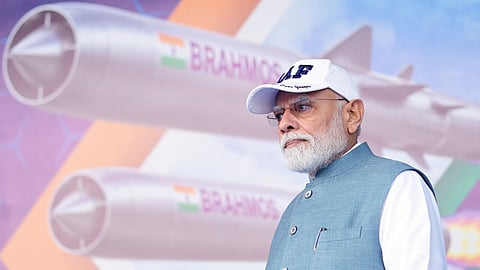

NEW DELHI: Putting tri-service jointness and home-grown platforms at the centre of its 94th anniversary display, the Indian Air Force (IAF) on Sunday flew nearly 100 aircraft from 12 bases over the Ganga at Namo Ghat, with Prime Minister Narendra Modi in attendance.
Incidentally, the Central Air Command-organised display was the first aerial show over the Ganga in Varanasi, the Prime Minister's constituency. The IAF has traditionally held its Air Force Day flypast at Hindon airbase near Delhi but in recent years has taken the celebrations to other cities, including Prayagraj in 2023 and Guwahati last year.
The finale of the three-day 'Wings Over Ganges' show was also attended by defence minister Rajnath Singh, UP governor Anandiben Patel, chief minister Yogi Adityanath and Air Chief Marshal AP Singh. "Varanasi air show… Magnificent!" Modi posted on X.
Officials said the display involved 52 fighters, 32 helicopters and 15 transport aircraft. Six frontline types, the Su-30MKI, Rafale, Jaguar, Mirage-2000, Tejas and MiG-29, flew together in a single arrowhead, a first for a public IAF display.
The formations drew on Varanasi’s cultural and spiritual heritage, with names such as ‘Kashi’, ‘Mahadev’ and ‘Vishwanath’. The display also featured aircraft and helicopters from the three services, along with platforms that support combat operations.
In the ‘Mahadev’ formation, an IL-78 tanker flew alongside three Mirage-2000 fighters. In ‘Nataraj’, a Navy P-8I maritime patrol aircraft, which took off from Arakkonam near Chennai, joined Mirage-2000s over Gwalior before proceeding to Varanasi.
A ‘Tridev’ formation brought together a Navy Ka-31 helicopter with IAF and Army ALH Mk-III helicopters. The indigenous Tejas light combat aircraft and LCH Prachand flew alongside the Rafale and Su-30MKI.
Three Kiran trainer aircraft traced the Tricolour in a ‘Kashi’ formation, while Mi-17 V-5 helicopters performed the ‘Omkar’ manoeuvre. The Surya Kiran aerobatic team and Sarang helicopter display team closed the show.
The display included mid-air refuelling, airborne early warning and maritime patrol capabilities, which support combat aircraft through aerial refuelling, surveillance and situational awareness. The IAF has highlighted these capabilities in its public messaging since Operation Sindoor.
Even as the IAF showcased tri-service formations at the Varanasi air show, Air Chief Marshal A P Singh struck a note of caution on theaterisation, saying the proposed structure must reflect India’s security needs rather than replicate foreign models.
In an interview with news agency PTI on the same day, Singh said theaterisation should not entail a permanent geographical division of fighter assets. He favoured centralised control with decentralised execution and a phased transition to ensure operational readiness is not compromised.
The Army and Navy have publicly backed theaterisation, describing greater jointness as inevitable for future warfare. The IAF, however, has repeatedly flagged concerns over the geographical segmentation of air power, particularly when it operates with a fighter strength of 29 squadrons against a sanctioned 42.
Furthermore, referring to Op Sindoor, ACM Singh said it was conducted under a joint architecture established by the Chief of Defence Staff and the three service chiefs. Centralised allocation and the swift reallocation of critical assets proved decisive, he said.
Future conflicts would be multi-domain, requiring the three services to plan and operate “far more closely than ever before”, Singh said.
ACM AP Singh took over as Air Chief in September2024 and is due to retire this month. He flew his final sortie as chief on October 20.
