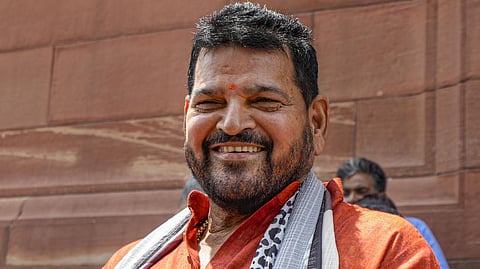

LUCKNOW: In a significant organisational reshuffle ahead of the 2027 Uttar Pradesh assembly elections, the BJP has inducted former Kaiserganj MP and ex-WFI chief Brij Bhushan Sharan Singh into its newly constituted state executive committee, marking his return to the party's core decision-making structure.
The revamped state executive, announced by UP BJP president Pankaj Chaudhary, will meet in Lucknow on Friday in the presence of Union Home Minister Amit Shah to chart the party's strategy for the 2027 polls. The inclusion of Brij Bhushan Sharan Singh is being viewed as politically significant as it comes nearly three months after his acquittal in a sexual harassment case filed by women wrestlers. According to party sources, this is the first time the six-time MP has been included in the BJP's state executive committee.
The move signals the rehabilitation of the influential eastern UP leader within the party organisation. Despite a political career spanning more than four decades and six terms in Parliament, Singh had never held a position previously either in the BJP's national leadership structure or the state executive, party leaders said.
The BJP had denied him a ticket in the 2024 Lok Sabha elections amid the controversy surrounding the allegations against him and fielded his son, Karan Bhushan Singh, from Kaiserganj instead. With his induction into the state executive, party observers see Singh regaining a formal organisational role at a time when the BJP is gearing up for the crucial 2027 assembly battle.
The newly-expanded state executive has grown substantially in size, from 184 members in the previous committee to 712 members, including special and permanent invitees. Senior BJP leaders, including Prime Minister Narendra Modi, Chief Minister Yogi Adityanath and Union Home Minister Amit Shah, are expected to play key roles as the party finalises its electoral roadmap.
The new commitee has 548 regular members; 134 spoecial invitees and 30 permanent members. The panel has highest 120 representation from Gorakhpur Region; 108 from Kashi Region; 104 from Awadh Region; 79 from Kanpur Region; 70 from West Region and 67 from Braj Region.
