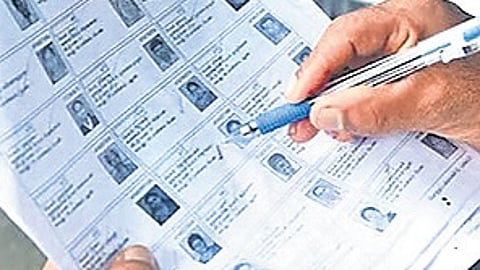

KOLKATA: Deletion of names of voters, mostly belonging to landless poor and lower middle-class groups, following the Special Intensive Revision (SIR) of electoral rolls in West Bengal, has ravaged several villages under the Beldanga Assembly constituency in Murshidabad district, around 250 km from Kolkata.
Residents have been left in anxiety ahead of the upcoming elections to the 294-member Assembly.
Mostafa Sheikh (40), a migrant worker; Abdul Tahid Sheikh (66), a landless farmer; Sutapa Mondal (25), a homemaker; unemployed Bibhas Ghosh (25); Mamoni Ghosh Mondal; and several thousand others from Jodupur, Kodla, Rangamati Chandpara, Majhira, Dabkai, Gobindapur, Kalitalapara, Nandipara and Dighirpara have been rushing to the district administrative office in Behrampore, seeking to know whether they can cast their votes in the upcoming elections.
They sought clarification from the West Bengal Chief Electoral Officer (CEO) on why their names were deleted after adjudication when the CEO visited the area on Saturday.
Mostafa Sheikh, a waste hair collector, returned to his village Jodupur from Gopalganj in Bihar after learning that his name did not figure in the electoral rolls of adjudicated voters published by the Election Commission of India (ECI) on 6 March.
To support his four-member family, including his wife and two sons, Mostafa collects waste hair through door-to-door drives in Mirganj, Gopalganj, and sells it at Rs 500 per kg.
He is now visiting the sub-divisional officer (SDO) office in Behrampore to find out when the appellate tribunal will open so that he can make a last-ditch attempt to have his name reinstated.
“I don’t know why my name has been removed from the final list. We are very old residents of Jodupur village for more than 80 years and have been casting votes in every election since I became a voter. The Commission called me for SIR hearing and I submitted all documents required as per the guidelines. Only my name has been removed,” Mostafa said, expressing helplessness, adding, “No political party visits us so that we can get some help in this crisis.”
Tahid Sheikh, a 66-year-old resident of the same village, could not find his name in the supplementary list cleared by judicial officers, though he had been voting in almost all elections for the past 40 years.
“We had submitted all documents to the Commission but my father’s name has been deleted from the supplementary list, where he has been stamped as ‘deleted after adjudication by judicial officers’. My father has found land deeds of more than 50 years and rushed to Behrampore with sheer anxiety and tension,” said Jainal Abedin, a Madrasa Para teacher from Jodupur.
Jainal claimed that a large number of voters, mainly belonging to the minority community, have lost their voting rights. Murshidabad is allegedly the worst-hit district. Out of 11,01,145 adjudicated voters, 4,55,137 have been marked ineligible, and a total of 7,48,959 names have been deleted from the district’s rolls.
Manob Kodla, a clerical staff member at a local state government school, said, “SIR has virtually ravaged several areas like Kodla, Kalitalapara, Nandipara and Dighirpara, which have a Hindu-majority population in Beldanga. Several hundred Hindus in these areas could not find their names in the supplementary list. All of them have been living here for generations with valid identity proofs.”
A large number of aggrieved villagers whose names have been deleted have sought clarification from the CEO, questioning why genuine voters were removed from the rolls.
“Take steps so that the names deleted in the SIR could again be included in the list; this is my request,” Taslima Biwi told CEO Manoj Agarwal while standing outside her home in Mahestala, Beldanga.
Agarwal, who was in Murshidabad to review election preparedness, visited Mahestala, which witnessed violent protests on 16 January over the death of a migrant worker in Jharkhand.
Flanked by armed central paramilitary personnel and followed by a crowd, the CEO stopped outside her home and asked whether there was an atmosphere of fear or intimidation in the village.
Taslima, seemingly unfazed by the presence of armed personnel, did not respond to his question and instead raised her concern.
“My request is simple: Make immediate efforts to include their names in the voters’ list. We will not be happy to see some people cry while others smile on polling day,” she said in Bengali, gesturing with her hands.
Visibly taken aback, Agarwal said, “With directives of the Supreme Court, judicial officers had handled the under-adjudication cases. The deletions of names have been done by the judicial officers. Let me see what I can do.” He also urged villagers to vote without fear.
