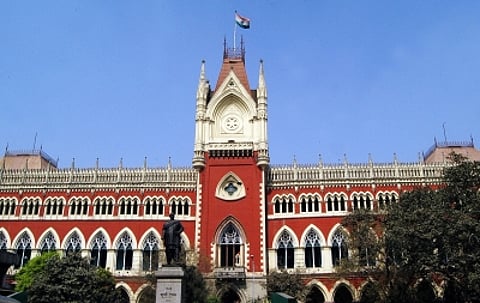

The Calcutta High Court on Monday set aside a man's appointment as an assistant professor at a college over his objectionable social media posts, while observing that the right to profess one's religion cannot be construed as permission to hurt others' faith.
The court's remarks came while hearing a plea filed by the Ramkrishna Mission College in West Bengal's Narendrapur against a single bench's September 4, 2025, order, directing the institute to appoint Tamal Dasgupta as an assistant professor of English.
A division bench led by Justice Debangsu Basak and also comprising Justice Md.Shabbar Rashidi held the candidate's social media posts had the potential of hurting the sentiments of the followers of other religions.
Noting that Dasgupta expressed strong views about religions other than that of his own, it held the candidate's contention that his fundamental right of freedom of speech and to practice religion were affected by the college's decision to refuse him appointment cannot be accepted.
The court also noted that Dasgupta had made social media posts prior to the West Bengal College Service Commission's recommendation for his recruitment to the position, expressing strong views on religions, the conduct of the Ramkrishna Mission of which the college is a part, and the monks of the order.
Passing the judgment last week, the division bench said, "Every person has the fundamental right to profess his or her religion."
"Right to profess such religion, however, cannot be construed to mean that such person is permitted to hurt the faith or the religious sentiments of any other person," the court observed.
The college authority had appealed against the single bench order that directed it to issue a letter of appointment to Dasgupta to the post of assistant professor in English at the college and to permit him to join that post within four weeks.
Setting aside the single bench judgment, the division bench held that the college's decision is in relation to a recommendation made by the West Bengal College Service Commission and has no bearing on either the freedom of speech of Dasgupta or his fundamental right to practice his religion.
"By the decision impugned in the writ petition, the college has neither prevented the writ petitioner (Dasgupta) from expressing his views nor restrained him from practising his religion," it observed.
Holding that the governing body of the college deciding that Dasgupta was unsuitable for the position was in the interest of the educational institution and was based on his social media posts, the court said its decision could not be deemed implausible.
"Once such a decision cannot be classified as not plausible, it cannot be held to be arbitrary," the division bench said, upholding the decision of the college authority.
It said the West Bengal College Service Commission Act, 2012, vests the educational institution concerned with the authority of offering appointment despite the recommendation of the College Service Commission.
The high court held that Dasgupta's candidature was considered fairly, and said that as a participant in a selection process, a candidate has a right of fair consideration, but does not possess an absolute right to the appointment.
The court held that a college within the purview of the Act has the right to refuse the appointment of a candidate recommended by the West Bengal College Service Commission provided that the decision is "bona fide, free of arbitrariness and in the best interest of the institution concerned".
The counsel for the college argued that the institute is run by Ramkrishna Mission, Narendrapur, a branch of the Ramkrishna Mission, a religious and charitable non-governmental organisation.
He stated that on taking up the recommendation of the commission, the college authority noted that the candidate made several public statements and social media posts from time to time, which were seen as strong views on religion and society.
Contending that such comments were completely antithetical to the fundamental ideas, ideals and philosophy of the Ramkrishna Mission, the advocate stated that the candidate appeared biased against order.
As such, the college's governing body did not accept the recommendation to appoint Dasgupta and communicated the decision to the Commission, he stated.
Dasgupta's lawyer contended before the court that the appellant college authority did not doubt his teaching capability.
The posts were personal in nature and had nothing to do with the petitioner's teaching capability, he had argued.
(With inputs from PTI)
