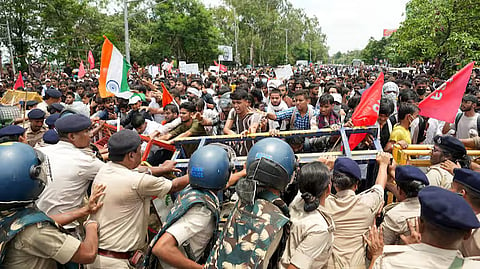

KOLKATA: The BJP government in West Bengal, led by Chief Minister Suvendu Adhikari, has invoked the West Bengal Public Safety and Control of Anti-Social Activities Act, 2026, also known as the 'anti-goonda law', for the first time after violence during a protest march organised by eight Left student organisations with the support of Cockroach Janata Party (CJP) members at Esplanade in Kolkata on Friday.
Seven cases were registered at Hare Street and Entally police stations under the Act in connection with alleged attacks on policemen and media persons during the protest against the alleged NEET paper leak, which demanded the resignation of Union Education Minister Dharmendra Pradhan. The Act was recently passed by the West Bengal Legislative Assembly.
Police said 70 people have been identified for their alleged involvement in the attacks on police and media persons at Dorina Crossing, Esplanade, where thousands of students and members of the public had gathered after a protest march from Sealdah railway station.
Addressing the Assembly on Saturday, the chief minister said the state government had implemented the 'anti-goonda law' for the first time since it was passed.
“The miscreants involved in the incident will be given strict punishment so that their three generations can keep it in their memory,” Suvendu said while expressing displeasure over the alleged attacks on police and media persons at Esplanade.
“Police were repeatedly provoked by the agitators but they were restraint. Everybody has seen how shoes and bottles were hurled on police. The protestors wanted police to resort lathicharge so that the ‘drama’ could continue but police didn’t allow them to take the opportunity,” he said in the House adding, “Seventy people have been identified but no one of them is student or CJP member. These people have no link NEET movement.”
He also named five alleged "goondas" — Afroz from Rajabagan, Nahid from Kidderpore, Tanbir and Nizam from Ekbalpur, and Rahul Jamal from Watgunj.
Police used water cannons, lathi-charge and tear gas shells to disperse the protesters after they assembled at Dorina Crossing, causing traffic disruption. Shoes, water bottles and stones were allegedly hurled at policemen during the confrontation.
Around 6 pm, police, along with the Rapid Action Force (RAF), carried out an operation to disperse the crowd and restore normalcy.
Earlier on Friday, Left student organisations, led mainly by the Students' Federation of India (SFI) with the support of the CJP, held a protest march demanding the resignation of Dharmendra Pradhan over the alleged NEET paper leak, dissolution of the National Testing Agency (NTA), and justice for students alleging police excesses during protests in Delhi.
Meanwhile, a petition challenging the constitutional validity of the West Bengal Public Safety and Control of Anti-Social Activities Act, 2026, has been filed before a division bench headed by Acting Chief Justice Tapobrata Chakraborty of the Calcutta High Court.
The Act expands the definition of "anti-social activities" to include acts that create fear or panic, threaten public order, obstruct lawful trade or business, involve illegal occupation of property, or result in large-scale economic and environmental offences, including illegal mining, unauthorised sand extraction, and forest and wildlife crimes.
The West Bengal Maintenance of Public Order (Amendment) Act, 2026, also brought into force by the BJP government, allows the government to attach and auction properties of accused persons to recover losses caused to public or private property during riots or violent protests.
