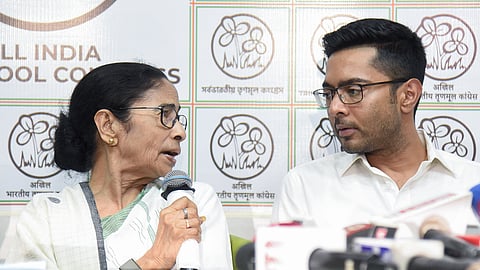

KOLKATA: In West Bengal politics, few relationships have shaped a party’s future as profoundly as the one between Mamata Banerjee and her nephew, Abhishek Banerjee.
The bond is familial, but its consequences have always been political. At 38, Abhishek Banerjee occupies a position unmatched by anyone in the Trinamool Congress except Mamata Banerjee herself.
Yet at a moment when the party is grappling with one of its most turbulent phases, marked by internal dissent, electoral setbacks and mounting questions over leadership, he finds himself at the centre of the storm.
To supporters, he remains the face of generational change. To critics, he is Bengal’s most prominent “nepo kid,” the beneficiary of political inheritance whose rapid ascent reshaped the party’s power structure and who is now being held responsible for many of its present troubles.
Once seen as the heir apparent, Abhishek has increasingly become the target of growing frustration and anxiety within the Trinamool Congress.
Mamata has many nephews and nieces, but party insiders have long maintained that Abhishek, the son of her brother Amit Banerjee and sister-in-law Lata Banerjee, enjoyed a special place in her political universe.
During the years when the Trinamool was battling the CPI(M)--led Left Front, he was among the few younger members of the family who actively identified with her political struggle.
That early association steadily translated into influence and then authority. After the Trinamool's historic victory in 2011, Abhishek’s rise was swift. He was handed charge of YUVA, a youth platform that critics saw as a parallel power centre, signalling that the nephew was no longer merely family. He was becoming the heir.
The move triggered unease. Senior leaders complained that a new authority structure was being created outside established organisational channels. Mamata brushed aside such concerns. But the symbolism was impossible to ignore.
The nephew was no longer merely a trusted family member; he was becoming a political stakeholder. By 2014, Abhishek had entered Parliament from Diamond Harbour. His rise thereafter was swift and unmistakable.
Unlike many Bengal politicians shaped by decades of street politics, Abhishek brought a distinctly managerial approach. Educated in Kolkata and later trained in business management, he embraced technology, digital outreach and data-driven political planning.
Online membership drives, social media campaigns and structured organisational reviews became central to his style.
The old Trinamool spoke the language of agitation. Abhishek increasingly spoke the language of strategy. That shift became even more visible after the BJP’s dramatic gains in Bengal in the 2019 Lok Sabha election.
Faced with a growing challenger, the Trinamool undertook a major organisational overhaul. Political consultancy firm I-PAC became deeply involved in campaign planning, voter outreach and feedback mechanisms. The experiment paid off electorally. The party returned to power with a decisive victory in the 2021 Assembly election.
Yet success did not silence criticism. Many within the organisation felt that traditional party structures were being overshadowed by consultants and data analysts. Veteran leaders complained that political instincts built through decades of grassroots work were being replaced by presentations and survey reports.
Over the years, he evolved into a polished political operator. His image became increasingly corporate and carefully managed. Supporters saw professionalism and modernisation. Critics saw distance from the grassroots culture that had built the party.
Formally, he is the national general secretary. Informally, he is widely regarded as the party’s number two.
Every organisational dispute, electoral setback or internal rebellion eventually circles back to the same question: has too much authority become concentrated around one leader and his inner circle? The pressure has intensified as legal and political controversies continue to follow him. Investigations, notices and prolonged questioning by agencies have kept him under constant public scrutiny.
Abhishek has consistently denied wrongdoing and described such actions as politically motivated, but the controversies have nevertheless complicated his political journey. At the same time, he faces the burden that accompanies every political heir.
For now, Abhishek Banerjee remains suspended between inheritance and achievement, between proximity to power and ownership of it as the Trinamool Congress fights an existential battle that none would see coming so early, and where he emerged as the villain.
