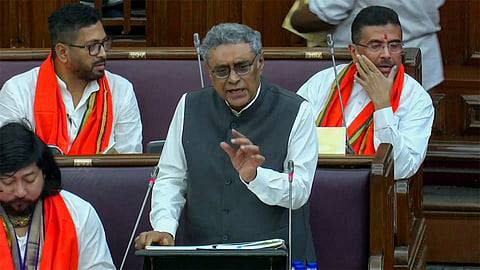

The BJP dispensation in West Bengal presented its maiden budget on Monday, announcing the filling of 1 lakh government vacancies, a 20 percentage point hike in DA for its employees, and a Rs 36,000-crore outlay for the financial assistance scheme for women, Annapurna Yojana.
Presenting the budget, Finance Minister Swapan Dasgupta said the government has inherited a debt burden of Rs 8.15 lakh crore from the TMC regime and stressed that fiscal discipline and administrative reforms were essential to restore public confidence in governance.
"Building a corruption-free administrative structure is a cornerstone of our vision. We have to restore people's trust in governance," he said, announcing a new citizen outreach initiative titled 'Apnar Sarkar, Apnar Pashe'.
Dasgupta announced that the dearness allowance of state government employees and the dearness relief for pensioners would be raised by 20 percentage points from October 1, taking the total DA to 38 per cent. It would narrow the gap between the DA for state government employees and their central government counterparts by 22 percentage points.
The finance minister said the budget had been framed with the objective of building a "modern, progressive and developed Bengal" in line with the vision of a "Viksit Bharat".
Projecting employment generation as a key pillar of the new government's agenda, Dasgupta announced that one lakh vacancies in government departments would be filled in phases, including 20,000 posts in the police department and 50,000 teaching and non-teaching positions in schools.
Thirty-three per cent of the jobs would be reserved for women, while a 10 per cent quota would be provided for Agniveers wherever applicable, he said. The upper age limit for government recruitment, already relaxed by five years, would continue for the next two years.
Seeking to reassure beneficiaries of welfare schemes in the face of the opposition's allegation that welfare programmes could be curtailed under the BJP dispensation, Dasgupta said all existing social welfare programmes would continue.
"Our objective is to ensure that the benefits of government schemes reach the weakest sections of society. Necessary reforms will be undertaken wherever required," he said.
A major chunk of welfare expenditure was earmarked for the Annapurna Yojana, with Rs 36,000 crore allocated.
Under the scheme, women aged between 25 and 60 years will receive direct financial assistance into their bank accounts.
The budget earmarked Rs 550 crore for free bus travel for women and announced the introduction of a "Pink Card" system for availing the benefit.
A new unemployment assistance programme, 'Bharosa', was announced, under which unemployed graduates from families with annual incomes below Rs 1 lakh will receive Rs 3,000 per month, while other eligible unemployed persons will get Rs 2,000, provided they are not covered by any other social welfare scheme. The government also enhanced old-age, widow and disability pensions by Rs 500 per month.
In a move likely to find support across party lines, the annual MLA Local Area Development Fund was increased from Rs 70 lakh to Rs 1 crore.
The budget also proposed a monthly pension of Rs 5,000 for retired journalists and Rs 10,000 for those who spent time in jail in what the government described as politically motivated or false cases.
Among welfare measures, the government announced a Rs 5,000 rise in the monthly remuneration for anganwadi workers, ASHA workers and para-teachers, while mid-day meal cooks will receive an additional Rs 1,000 per month.
Civic volunteers, Green Police personnel, NVF workers, Prani Bandhu and Prani Mitra workers will get an additional Rs 2,000 per month from August.
In the health sector, the government allocated Rs 3,100 crore for the implementation of Ayushman Bharat, which is expected to cover nearly seven crore people in the state.
The allocation for mid-day meals was enhanced to Rs 10 per student, with ISKCON expected to assist in food preparation and distribution.
The education sector figured prominently in the budget, with proposals for a Tribal University and two Kendriya Vidyalayas in Jhargram, women's universities in Contai, Kaliachak and Falta, and a one-time grant of Rs 25,000 for students of government and government-aided colleges preparing for competitive exams.
The government also announced plans to facilitate the establishment of an IIT and an IIM in north Bengal and launch a state Artificial Intelligence Mission.
It also proposed installing sanitary pad vending machines in schools.
On the sports front, the government announced a Sports University, an international-standard stadium in north Bengal and mini indoor stadiums at a cost of Rs 5 crore. Clubs participating in national games will receive assistance of Rs 1 crore each, while Rs 20 crore has been earmarked for Khelo India activities in the state.
The government allocated Rs 900 crore for the proposed Chingrighata-New Town elevated corridor and Rs 1,200 crore for a new bridge over the Bhagirathi river. It also proposed a deep-sea port at Dadanpatrabar, a four-lane bridge over the Mayurakshi river in Birbhum and metro rail projects in Durgapur, Asansol and Siliguri.
To ease pressure on Kolkata airport, the government will identify 1,000 acres in Kalyani for a greenfield airport.
Airports have also been proposed in Purulia and Malda, while land will be earmarked for the expansion of the Hasimara and Kalaikunda airfields.
The budget allocated Rs 100 crore for strengthening communication infrastructure in the Sundarbans and Rs 50 crore for riverbank protection and rehabilitation in the Jangipur region.
Measures aimed at boosting north Bengal's economy included reducing the minimum land requirement for commercial tea estates from 30 acres to 15 acres.
The government also proposed expanding the Maa Aahar programme by opening four additional centres in urban areas, where fish-and-rice meals would be made available at nominal rates.
Allocations for the VBG-RAM G scheme were enhanced, and 25 lakh new beneficiaries are proposed to be brought under its ambit.
