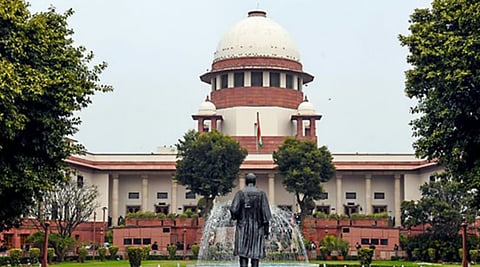

The Supreme Court has observed that billing discrepancies and service-related grievances are primarily civil in nature, while quashing a criminal case filed against the Narayana Multispecialty Hospital in West Bengal's Barasat.
A bench comprising Justice Pamidighantam Sri Narasimha and Justice Alok Aradhe, in a judgment delivered on Tuesday, set aside a 2023 order of the Calcutta High Court, which had suggested that a prima facie criminal case was made out against the hospital and its chairman.
The case stemmed from a complaint filed by a man whose mother was treated for a fractured femur at the hospital in 2021.
The complainant alleged that the hospital intentionally charged Rs 2,500 for an HRCT test that was never performed and failed to provide medical records promptly.
An HRCT (high-resolution computed tomography) scan is a specialised imaging test that provides highly detailed, cross-sectional, 3D images of lungs and chest tissue.
He further alleged that hospital staff behaved improperly and issued threats when questioned.
On the basis of these allegations, a magisterial court had issued notices against the hospital, its chairman, and staff under Sections 406 (criminal breach of trust), 420 (cheating), and 120B (criminal conspiracy) of the IPC, along with provisions of the West Bengal Clinical Establishments Act, 2017.
The hospital maintained that the HRCT test was initially proposed but later deemed unnecessary by doctors and said once the error was identified, a revised bill was issued.
The top court held that the essential "foundational ingredients" of criminal offences alleged against the hospital were missing.
It said for the commission of offence of cheating, there must be a "dishonest intention" from the very beginning.
In this case, the billing discrepancy appeared to be an "inadvertence" rather than a fraudulent plot, especially since the hospital proactively offered a refund.
On criminal breach of trust, the bench found no "entrustment" of property for a fiduciary purpose and said a hospital bill payment is a commercial transaction, not a trust-based entrustment.
It said since the main offences were non-existent, the charge of criminal conspiracy could not stand independently without proof of a prior agreement to commit an illegal act.
"In view of the above discussion, we are of the opinion that the allegations made in the complaint, even if assumed to be true in their entirety and accepted at face value, fail to disclose the commission of any offence under the Sections invoked against the accused persons," it held.
It said the complaint, which also alleged non-supply or delay in supply of medical records, falls short of constituting a criminal offence.
"At the most give rise to some kind of a claim in civil law or a statutory requirement under West Bengal Clinical Establishment (Registration, Regulation & Transparency) Act, 2017 or the Indian Medical Council (Professional Conduct, Etiquette and Ethics) Regulations, 2002," it said.
The bench said it was a fit case for quashing the criminal complaint.
"Quashing of the criminal complaint will have no bearing on the civil or statutory remedies that the complainant may exercise in accordance with law," the bench said.
(With inputs from PTI)
