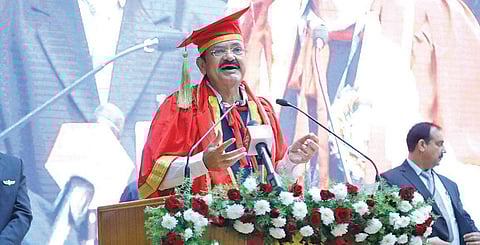

HYDERABAD: The growth and development of an economy is dependant on its skilled manpower. The destiny of our country is shaped in our classrooms and this was what the Indian Education Commission set up in 1964 said in its report and I could not agree more as I strongly believe knowledge, skills and attitude of the students lay the foundation of the nation building. I am delighted to be the part of the eighth convocation of the Gandhi Institute of Technology and Management (GITAM) which has carved a niche for it by offering quality higher education.
The GITAM has been imparting quality higher education for more than 37 years. With three picturesque campuses in Andhra Pradesh, Telangana and Karnataka, the university is offering 144 UG, PG and doctoral programmes in diverse subjects to its 20,000 full-time students, 1,200 research scholars and more than 60,000 students in the distance mode. With the multi-disciplinary approach, the university is among the few universities that have implemented the 'Choicebased Credit System (CBCS)', ensuring flexibility in learning process beyond the core discipline and helping students pursuing the career of their choice.

I am happy to note that the GITAM has established Centralised Research Laboratories in key thrust areas such as water quality, nanotechnology, medical biotechnology, and advanced materials & processing. Setting up of research centres in the areas of cancer, urban & sustainable development, integrated rural development, climate change & disa s t e r m a n a g e m e n t i s commendable. With a great foresight, the GITAM has taken the lead in introducing the state-of-the-art courses in many disciplines. It is the first university to set up a Fin- Tech Academy and offer academic programmes in blockchain technology. The GITAM has taken the initiative to provide students with a world-class learning experience.
As part of the move, it has signed MoUs with a number of reputed global universities for collaborative research. It has entered into a pact with the Stanford University to develop the discipline of advanced biotechnology and life sciences, apart from creating a Centre of Excellence. The students must dream big and set their vision high. The world is full of opportunities now and they must learn to seize them. As Swami Vivekananda had said a hundred years ago— awake, arise and stop not till your goal is reached—the key is to keep learning and utilising the skills to transform the society. The world has fallen vulnerable to unprecedented changes in many spheres of human life. Only innovative technologies and creative disruption can help us strive.
The students must develop the abilities to separate the wheat from the chaff and be wise enough to choose the best option available in their kitty to make this planet a better place to live. The nature of our economy is also changing. This is the age of the fourth industrial revolution and the advanced digital technology and robotics are making certain types of jobs obsolete. But, the scenario should be analysed with an optimistic vision, as the same technologies are opening hordes of opportunities too if the jobs and careers are the questions.
We must prepare ourselves to cope with the changes. We must be pro-active and agile enough to ride the waves of change. The Government of India is fully aware of the changing environment and is relentlessly reorienting itself to keep a date with it. The government has taken many measures to transform the country into a digital economy. For example, the ‘Make in India’ ‘Start-up India’ and ‘Standup India’ initiatives are committed to giving a fillip to the manuf a c t u r i n g s e c t o r a n d entrepreneurship.
India is on the cusp of a massive transformation in all spheres and we must accept it as an opportunity. Keep your eyes open, lend your ears to the ground and shape up your future in the areas of your choice. I am happy that the Telangana Government has come up with a credible industrial policy to make the State a sought-after destination for domestic and global entrepreneurs. Already a hub for IT, biotechnology and pharma industries, Hyderabad has become the second largest exporter of IT products in India with around `67,000 crores of exports. In sync with the vision of the Centre, the Telangana Government has established the T-Hub to attract the best start-ups and entrepreneurs from across the world to Hyderabad.
Major IT giants like Microsoft, Infosys and Wipro are already functioning from Hyderabad. The students must realise that if they do not restrict their visions and have a firm knowledge base and the right skillsets, they can scale new heights. I wish to highlight here the great role the faculty can play in transforming the universities into the crucibles of positive changes. It's time we paid attention to not only ‘what should be taught' but also to the ‘how’ factor associated with it. Economic growth of a country is highly dependent on the creative and innovation capabilities of its human resources and this can be achieved through research and development.
I urge the faculty to devote time to relevant research projects. This will improve the intellectual stature of the universities, making them the powerhouses of knowledge. Now, the university must don the hat of potential thinktank and contribute to the shaping up of the national policies. Challenges versus Inter-disciplinary skills Our country is facing a plethora of challenges like global warming, environmental pollution, loss of biodiversity, urban migration, increasing demand for energy, shortage of drinking water, lack of safe waste disposal mechanisms and fuel-inefficient transportation.
The universities can fill the gap by equipping the students with the multidisciplinary knowledge and inter-disciplinary skills. I would like to commend the GITAM for introducing such interdisciplinary courses like cyber forensics and information security, FinTech, pharma chemistry, food science and technology, and other programmes. There is also a need to set up technology incubation centres in universities to develop the entrepreneurial skills among students and the GITAM University has already established two such centres and enabled its students to establish more than 24 start-ups. I have no doubt that you will always remain proud alumni of this great institution and dedicate a part of your time to maintain the pre-eminence of your alma mater.
I am proud to be a part of this convocation as it gave me the opportunity to meet the young and dynamic graduates. I offer my best wishes to all the students who received degrees, prizes, medals and honorary doctorates today. I am sure they will achieve new heights in their career and lead an excellent life. I hope you will continue to learn, earn and yearn to serve the country with a clear vision and strong shoulders. We need leaders who will walk the talk and be bold enough to walk on the roads less travelled. I congratulate the management of the university, the Chancellor, Vice-Chancellor, the team of academic leaders for setting up a high benchmark in offering quality education and contributing to the nation-building.
Role of universities
Gone are those days when the role of universities is confined to offering quality education. Shaping up global citizens is the need of the hour and the onus now is on the universities. The world is shrinking into a global, thanks to information technology. The universities of this era need to build the competencies needed for functioning effectively in this global village. This calls for a change in attitude and mode of learning. Students should be equipped with the know-how to access, adopt the new technology. They should be trained to collaborate, coordinate and compete in a challenging environment. They should aim for excellence and efficiency, not be settling for mediocrity or business-as-usual approach. India is on the threshold of emerging as a major economic power. We are an old civilisation with a young population. No other country is having such a demographic advantage.