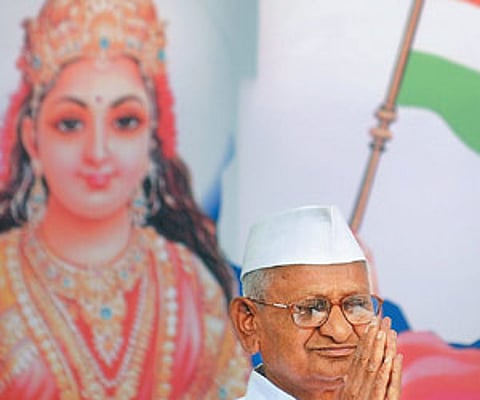

NEW DELHI: India has a new Mahatma who has emerged from the tsunami of civil society’s rage against corruption. The four days that shook the Government was only the climax of a considered, sustained, well-planned and well-employed effort that took many days and nights to complete. It involved a select group of activists, thinkers, lawyers and cause hungry celebrities and was orchestrated by a vast, well-oiled machinery of individuals all over the country who helped transform Annatma’s fast into a national movement that attracted an Indian middle class thirsting for an icon where earlier attempts like Baba Ramdev’s had failed. Brand Hazare was born in the heat and dust of Jantar Mantar, but it was conceived in the drawing rooms of New Delhi. It was a revolution that received fabulous TRPs, was Facebooked and Tweepled. Even NRIs joined in. There were gripes, too; many of Delhi’s professional intellectuals were disappointed—after all, Hazare was not a PLU (People Like Us).
How did Annatma become the talisman of this mass movement that gave urban Indians their Rang de Basanti moment? As the Marxists say, a revolution happens for two reasons.
One, when the conditions are ripe for it. Two, when there is an intellectual elite plotting it at the drawing board and steering it on the ground.
The evolution of Kishore Baburao Hazare, aka Anna Hazare, from a Maharashtra- based anti-corruption crusader to a veritable neo- Gandhi happened thanks to a group of activist-professionals united by rainbow ideology but who were without formal political lineage. The group comprised RTI activist Arvind Kejriwal, retired supercop Kiran Bedi, eminent lawyer Shanti Bhushan, oncologist Sanjeev Chhiber, activist-at-large Swami Agnivesh and sundry activists of campaigns like India Against Corruption (IAC).
Starting January 2011, they met every Monday at Chetanalaya, a building opposite St Columba’s School in central Delhi. They were passionate about fighting the corruption that was eating away at the system which lacked an effective watchdog.
It occurred to Arvind Kejriwal that the Lokpal Bill—a 42-year-old pending legislation which would make the Government accountable to the people— was gathering dust and various governments had been dragging their feet.The Bill had been tinkered with by so many previous governments that it had become an apology— the judiciary and the PM were immune from the Lokpal’s reach, the ombudsman had no suo motu powers and whistleblowers were exposed to retribution.
The need of the hour was an independent ombudsman functioning without fear or favour.
Lawyer Shanti Bhushan was entrusted with the task of drafting the Jan Lokpal Bill. Says Kejriwal: “The text of this bill has been written on the streets of India.” Finally, they had a movement, but no icon to lead it. Since most of the planners were members of India Against Corruption—Ramdev, Sri Sri Ravishankar, Mahamood Madani, Archbishop Vincent M. Concessao, Swami Agnivesh, Kiran Bedi, Mallika Sarabhai, Justicze D.S.Tewatia, Arvind Kejriwal and more—it was easy to propose a fellow member and Gandhian, Anna Hazare.
Anna was brought to Delhi and Kiran Bedi played host at her residence until the preparations for the fast were in place.
The time seemed right. The Jasmine Revolution was spre ading its democratic fragrance and the headlines and scenes of protest inspired the Indian middle class. The dam broke. Aamir Khan, who had foreseen this in his film in 2006, called for popular support to Hazare. Even the anti- progress activist who has an uneasy relationship with the Indian middle class, Medha Patkar, jumped on the Hazare bandwagon.
“What is wrong in the middle class joining such a movement?” Medha asked on Friday afternoon, hours before Anna announced the end of his fast. “They too have a right to voice their dissent and demand correction.” Many expressed doubts abo ut the real organisers. Congress ministers and spokesmen raised the RSS bogey. But Hazare’s neo-Mahatma profile carried the movement safely through partisan interests.
RSS spokesperson Ram Madhav was among those who were seen on the dais on Friday.
A senior member in the organising group said Kejriwal was responsible for the details.
“There is some external funding, but the source is not known to us; it may be NRIs, the RSS or corporates,” he said.
“There are 200 NGOs which participated— each has own corpus. In any case, SMS and Facebook have made revolution cheap. But don’t forget, Kejriwal is a good friend of Rahul Gandhi.” Whatever it took only a day after Hazare began his fast on April 5 for India to open its arms wide.
