
COLOMBO: Sri Lanka missed the bus once, but it’s damned if it’s going to do it again.
Back in the 1980s, when Princess Diana chose a Ceylon Blue Sapphire for her engagement ring, the island’s gem industry didn’t realise the marketing opportunity it had missed by not tom-tomming the princess’ choice. Not this time.
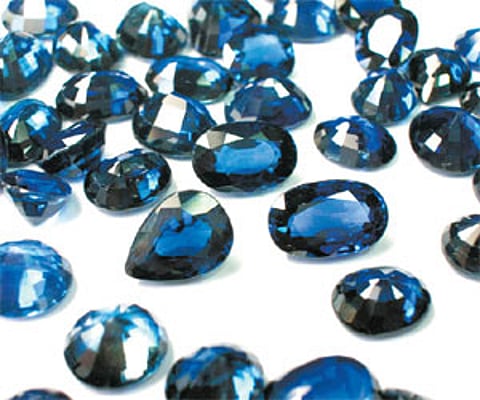
Almost the whole world now knows that the cornflower blue stone glittering on the finger of Kate Middleton, who married Britain’s Prince William on Friday, was mined in Sri Lanka. It was Janaka Ratnayake, chairman of the Sri Lanka Export Development Board (SLEDB), who hit upon the idea of publicising the Ceylon Blue Sapphire’s “royal” connections. “We missed the opportunity to link the gem with royalty when Diana wed Charles in 1981. We should have gone to town then, saying that the sapphire in Diana’s ring had been mined right here in Sri Lanka, but we let the event pass.
When we learnt last year that Prince William had gifted Diana’s ring to Kate, we were determined not to miss the bus again,” Ratnayake says.
With this in mind, the Sri Lanka Gem and Jewellery Association (SLGJA) approached advertising agency Grant McCann and Erikson to create a campaign highlighting the “royal” qualities of the Ceylon sapphire that could be released internationally.
Delineating the strategy behind the promotion, Neela Marikkar, chairperson of the agency, says: “We knew that the royal wedding of 2011 would be a far greater media event than the one in 1981, given the explosion in the media scene since then.
The enormous increase in the electronic media and the onset of online communication has made one’s reach global. So we decided to target people largely through new media.”
Grant created the website www.ceylonsapphire.co.uk to tell the world (and particularly Britain) about Kate’s ring, the uniqueness of the Ceylon sapphire, and its historical association with royalty.
The print and electronic media were not ignored. Some 250 international journalists who were covering the wedding were given a press kit including a gem-studded, silver-plated tea spoon with the URL www.ceylonsapphire.co.uk engraved into the handle.
The reaction was all Sri Lanka hoped for. “Newspapers in the UK and overseas kept carrying stories on Kate’s ring, specifically its links with Sri Lanka,” says Ratnayake.
These reports were then put on the website for a multiplier effect. The site was updated frequently with news about the wedding preparations, not losing out on any of the juicy tidbits. But it also acted as a window to the world of gems and jewellery and associated fashions, with an accent on Sri Lanka.
The second stage of the campaign was the creation of a Ceylon Blue sapphire and diamond hair pin, which was gifted on behalf of SLGJA to Kate Middleton to wear on her wedding day. The sapphire in the hair pin was to act as Kate’s ‘something blue’ in the tradition of weddings where the bride must wear ‘something old, something new, something borrowed, something blue’, the association said. The hair pin was delivered to the Middleton family home in Berkshire and the story fed to the press, getting instant coverage on popular wedding blogs.
Explaining the rationale for not going in for a large-scale advertising campaign, Ratnayake says: “Firstly the gem is not a manufactured item, but a mined item. Secondly, it is a rare item and an expensive one at that. So, we have to target the relatively small but high end of the market.”
The SLEDB is silent on how much the campaign has cost. Ratnayake says the expense is in the region of a “few hundred thousand dollars” but refuses to be precise. But he’s got cause to be pleased. Jewellers everywhere are overwhelmed with orders for replica rings, with some retailers reporting an 800 per cent increase in sales of sapphires. “In the US, which is a major market for Sri Lankan gems, the demand for the stone has surged in the past few weeks,” beams Sheriff Abdul Rahuman, an SLGJA office-bearer.
