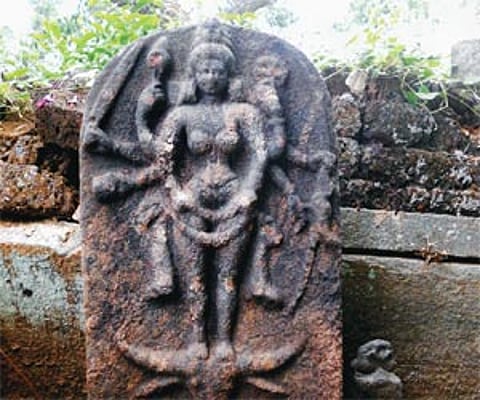

PALAKKAD: A beautiful eight-armed sculpture of goddess
Durga belonging to the medieval period was found in the sanctum of a ruined circular shrine located at Chelakad in Kannadi panchayat recently. The idol was discovered by K Rajan, assistant professor of the Department of History at the Government Victoria College.
Rajan, who was conducting a survey of ruined temples as part of a research, said that this idol showed that the worship of Durga in the form of Mahishasuramardini was popular in Kerala. This is one of the most beautiful sculptures of gods and goddesses found in the state. The image of Durga is engraved on a one-metre granite slab erected on a ‘peetom’ (granite platform). In front of it is another platform on which is seen the end of a linga. The main deity, going by the size of the image of the goddess, is Durga. Durga, standing on the head of a buffalo, is among the earliest forms of representations of the goddess in the country. This is symbolic of the killing of the Mahishasura by Durga, said Rajan.
Unlike in other parts of the country—including West Bengal, Assam, Bihar, Uttar Pradesh, Maharashtra, Karnataka and Tamil Nadu—the Durga image at the ruined shrine in Palakkad lacks ornamentation other than the rope-like object across the hip.
However, the representation of the goddess as bearing arms of various types is comparable to those in other parts. The goddess, standing erect and carrying a conch, sword, disc and bow, is not in a ferocious mood. The buffalo, on which it stands, may be the head of the buffalo-headed Asura. Durga standing on the head of Mahisha with two feet is said to be part of the early tradition in the south, especially in Tamil Nadu, said Rajan.
“The sculpture belongs to the medieval period. More research is required to date the sculpture which denotes Mahishasuramardhini,” said Prof V Selvakumar, assistant professor, department of epigraphy and archaeology, Tamil University, Thanjavur.
