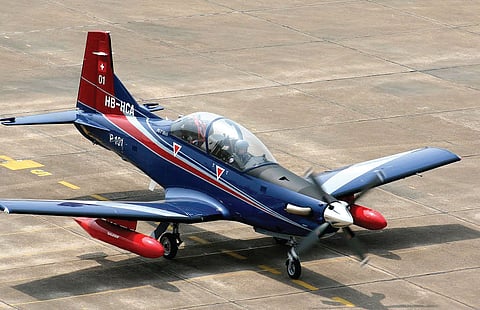

A dog fight has broken out between Indian Air Force (IAF) chief Air Chief Marshal NAK Browne and Hindustan Aeronautics Limited (HAL) Chairman and MD R K Tyagi over who should supply the Basic Trainer Aircraft (BTA).
The spat started after HAL said it was presented with unrealistic requirements over HTT-40s, while the IAF later diluted the same for the Pilatus it bought.
IAF sources said that the requirements given to HAL for trainer aircraft were drafts based on what the HAL said it could design and develop. The tender issued later on approval from the Defence Ministry had Air Staff Qualitative Requirements (ASQRs) that cannot be “amended, altered, dropped or dispensed” with. It also claimed that the same were given to HAL as the IAF’s final requirement for indigenous aircraft. The Air Force argued that the “real” cost of the domestic planes at 2011 prices was Rs 43.59 crore a unit—40 per cent more expensive than the Swiss planes.
“By the current foreign exchange rate, the PC-7 will work out to Rs 38.3 crore each. At 2013 prices, the HTT-40 will be Rs 47.6 crore each, or perhaps 25 per cent more. The price of the former is frozen under the option clause for deliveries up to 2017,” said IAF sources. The HAL claimed that the cost of the Swiss plane, considering the Exchange Rate Variation (ERV), has already escalated to Rs 38.36 crore, which was 27 per cent higher than when it was purchased. It also argued that the Life Cycle Cost of the 181 planes would work out to Rs 18,169 crore—about 40 per cent or Rs 5,000 crore higher than the HAL’s trainer aircraft, which over a period of 30 years would cost only Rs 13,263 crore. HAL says IAF selectively factored in foreign exchange variations in the procurement of HAL planes. The entire fleet of IAF’s original trainer aircraft—the HAL-made Hindustan Piston Trainer-32s—was grounded in a hurry in September 2009 after many trained pilots were killed in a series of crashes. The planes have been used to train over 2,000 IAF pilots, logging more than four lakh flying hours during their service life spanning three decades. IAF pointed out that the planes were four decades old and have outlived its utility; the stalling of their obsolete engines was too dangerous for the pilots. “Their grounding was a well-thought decision to save the lives of pilots. It’s the same in the case of buying the Pilatus plane,” a senior IAF office said.
The HAL, however, complained that the IAF did not agree to continue flying its planes despite all safety features it suggested were incorporated. It also noted that the IAF had twice rejected its proposal to design and develop a trainer plane to replace the HPT-32 beginning 1990, but agreed to the idea only in the middle of the last decade. HAL contended that building an indigenous trainer aircraft would help boost indigenous manufacturing capability so that India does not depend on foreign players. It also noted that the Pilatus deal had not established a Maintenance Transfer of Technology, because of which India will continue to rely on the Swiss firm for future maintenance.
Rookie pilots get their first, primary training on the basic trainer aircraft for six months. They progress to speedier but sub-sonic aircraft such as HAL’s Kirans and BAE Systems’ Hawk advanced trainer planes in the next two stages of training, before graduating to supersonic MiG-21 combat aircraft.
