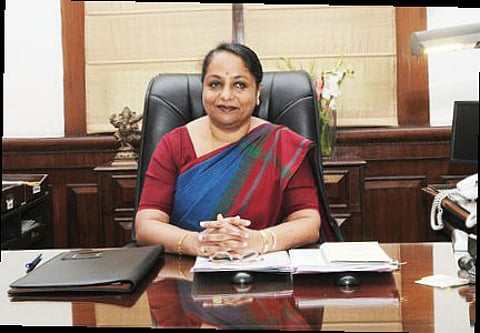

With Sujatha Singh in place as the new Foreign Secretary, there is already talk in the corridors of South Block of changes in the way the ministry will function from now on.
To begin with, Singh has offered to listen to her colleagues on what needs to be done to make the ministry’s functioning and India’s diplomacy more effective. She will be overseeing a major overhaul in the training of Indian diplomats—new and old.
The importance that Singh plans to give to ‘housekeeping’ was amply demonstrated, when she chaired a meeting of all joint secretaries and above level officers on the first day of assuming office on August 1.
According to sources, the foreign secretary was more in a listening mode, interested in hearing from the assembled senior officials about their ideas, out-of-box suggestions for making the ministry, and its human resources, more effective. “She noted that while the ministry has expanded its recruitment, it will take about seven-eight years for the impact to be felt. She, therefore, asked for views on what could be done in the meantime,” said a senior IFS officer.
Then, one by one, officials spoke up with their ideas, leading to free-wheeling discussion. “One officer said that perhaps, staff at the Indian mission abroad could be rationalised and could be brought back to headquarters as there are many posts vacant here. But, it was countered by another officer noting that missions are also understaffed,” he said.
Compared to foreign offices of other major powers, the MEA is rather under-staffed, with only about 4,000 employees. This includes over 850 officers from the elite IFS. After Cabinet approval in 2008, a plan to double IFS strength is being implemented, by increasing the batch size to about 30-40 officers.
One of Singh’s first priorities is likely to be to finalise new ambassadorial postings, as about two dozen openings are set to open up due to completion of term or retirement of the incumbent. This includes key position like China, Russia, United States, Thailand, Malaysia and several African and Latin American countries.
The foreign secretary reportedly asked officers to mull over and give suggestions, indicating that such meetings to improve the ministry’s resources would be more periodic.
She felt that she would like to hear the views of junior IFS officers. Towards that, the first meeting of the Indian Foreign Service Association with its new head took place on Saturday afternoon for about two hours. According to sources, Singh has been always keen to give more attention to the needs of younger officers—perhaps, a legacy of her posting as joint secretary at the Foreign Service Institute, the MEA’s training academy. In fact, officials reminisced that at the FSI, she had been highly involved in the training regimen, attending all lectures and even travelling with the probationer officers on their visits across India. Incidentally, Singh’s term will also coincide with the implementation of the New Training Framework drawn up by the ministry. In fact, in the last week of July, as a foreign secretary-designate, Singh, along with secretaries and the then foreign secretary had an interaction with 2012 IFS batch to kick-off the new framework.
Sources said that the new policy spells out for the first time, the training requirement for various cadres of the external affairs ministry—from IFS to the interpreters and legal officers. The framework states that a diplomat would undergo training at four stages in his or her career—entry-level, followed by about five to eight years into the job, then another after about 13-17 years in service, followed by another module at 20-25 years of service.
