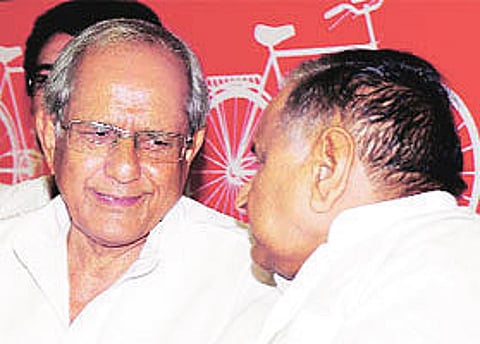

In Uttar Pradesh, agriculture minister Anand Singh, a royal scion, is going out of his way to connect with the poor farmers of the state and address their woes. Singh, agriculture minister in the Samajwadi Party government heads the famous Mankapur Estate of Gonda district. Having studied at prestigious schools and colleges in Lucknow and Delhi, he is popularly called “Raja Sahib” by his colleagues and party chief, Mulayam Singh Yadav. Yet, he believes in mingling with the farmers to know the problems. Singh has dedicated himself to the socio-economic welfare of UP’s poor farmers who constitute more than 85 per cent of the community.
He told The Sunday Standard, “I am pained to learn that in an agrarian state like Uttar Pradesh, farmers have committed suicides owing to poverty and debts. I have vowed to change the existing system and their pathetic economic condition. It is also my party’s agenda.” Majority of the farmers in UP are not in a position to buy machines for ploughing and harvesting as the cost ranges between Rs 6 lakh and Rs15 lakh. He added, “If the farmers of Eastern UP and Bundelkhand get proper attention and their grievances are solved, UP can make long strides in agriculture.” Singh adds, “I have asked the department to create small clusters of farmers and rent the farm machines at subsidized rates. This would reduce their dependence on labourers”. He feels strongly about the need for mechanisation of farming. He adds, “Food security of the country would be threatened in the decades to come and UP has to take the lead in this direction.”
Since Singh took over as agriculture minister last year, the fertilizer crisis has largely evaporated. Earlier, there were incidents of caning of farmers for fertilizer and seeds. Now, seeds and fertilizers are supplied to the block level. The government’s focus is on conducting soil testing at village level. In the previous years, hundreds of bags of fertilizers were smuggled out of the state into Nepal. The Centre had asked the UP government to stop siphoning off of the fertilizers.
The concerted efforts of the agriculture minister with his team including the principal secretary, Devashish Panda and the director, agriculture have started showing the results. “With an anticipated production of nearly 146 lakh metric tonnes, this is the first time when UP is going to record highest production of paddy in the November,” reiterates Singh. “Had flood not perished the paddy saplings, production would have reached 150 lakh metric tonnes,” said an official.
Previous highest production of paddy was 143 lakh mt in 2011. Under Singh, the agriculture department has ensued easy and timely availability of basic inputs like cheap and quality seeds, fertilizers and required pesticides. But Singh has critics. “The Samajwadi Party government has failed to provide relief to the farmers. They were compelled to sell off their wheat to the private market,” said BJP MLC Hridaya Narain Dixit. Dixit feels the government has failed to purchase half the quota fixed by it from the farmers and the traders are exploiting the poor farmers.
On the issue of power crisis Singh says, “In just one year everything cannot be changed. A derailed system is being brought back on the tracks. UP will see a historic decision in place—that of having an exclusive agriculture power feeder for irrigation purposes. The farmers will have substantial power supply for irrigation once the agriculture feeder is installed. Once implemented, it would revolutionlise agriculture and the cost of the farm produce would be drastically cut down.” Congress MLA, Akhilesh Pratap Singh differs. He says, “Whatever be the claims of the UP agriculture minister, the farmers are not getting even the cost of their produce. The cost has doubled up because of the acute power crisis in the rural areas in the state.”
