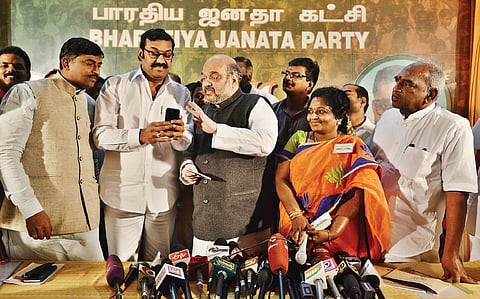

CHENNAI: The one question that is on everybody’s lips and mind after the visit of BJP leader Amit Shah to Tamil Nadu is whether the saffron party will succeed in its mission 2016 to capture power in the Dravidian heartland.
The goals have been set, the strategy at the micro and macro level has been drawn and there is a perceived power vacuum in the state, which sees alternate regimes of the two Dravidian majors. But, other questions persist. Can the party, which chants Lord Ram’s name, alter the equations in a land where poets hail Ravana and politicians burn Lord Ram’s portrait as a form of protest?
Amit Shah should consider himself lucky as he did not begin his mission in the seventies and eighties when both the Dravidian parties were vying with one another to support the Tigers, raise reservation quota and oppose everything ‘Aryan’. After the advent of AIADMK supremo J Jayalalithaa and the participation of the DMK in the Union government for more than a decade, the wicket is not that sticky.
The saffron party, for the first time in Tamil Nadu, has crossed 5 per cent votes in the 2014 Parliament elections. The vote share of all other parties barring the AIADMK and DMK is less than that of BJP, which takes the third position. Now, the party is looking to move further and the BJP President’s visit has added to the impetus. “After Amit Shah took charge, we have won several Assembly elections. At the moment, the major task he has assigned to the Tamil Nadu unit is to recruit members. At the moment, we have ten lakh members and we are aiming to increase it to one crore,” said L Ganesan, BJP national executive member and former state party president.
However, the idea is disputed by political analysts who say that it will be a very tough task in Tamil Nadu. VMS Suba Guna Rajan, a political analyst and research scholar in Dravidian politics, said, “I admit that there is a power vacuum in the state at the moment. But, the probability of BJP filling the space is not that easy. There are several factors which go against such a possibility".
First, Tamil Nadu politics is personality oriented. It revolves around charismatic leaders like K Kamaraj, Anna, MGR, Karunanidhi and Jayalaltihaa. BJP does not have any charismatic leader matching Jayalalithaa or Karunanidhi at the state level. “It faces a similar problem that Congress encountered. After the Dravidian parties snatched power, even a charismatic leader like Indira Gandhi who was loved by all sections of Tamils was not able to break their hold due to lack of popular leaders at the state level,” said Rajan.
Secondly, the party’s strategy of raising issues close to the hearts of Tamils and appealing to their sentiments by hailing Tamil savant Tiruvalluvar and Chola king Rajendra is confused by contrasting voices of leaders like Subramanian Swamy and H Raja, whose utterances are deftly used by other leaders to portray the BJP as anti-Tamil. “Thirdly, the party has a problem in retaining alliances and finding new alliances with the existing allies walking out or thinking of quitting the front,” added Rajan.
However, BJP national secretary H Raja dismissed the idea of personality oriented politics and asserted that the BJP had proved it wrong in many states. Organisation is more important than individuals. “BJP has proved it in Haryana and Jharkhand. Our party has changed the whole trend and emerged victorious in both the states. Tamil Nadu will not be an exception. Here too, we will disprove the charismatic leaders theory and succeed,” he said.
“Our front has polled 19 per cent votes in the recent Lok Sabha elections. This shows that the people are supporting a new front. The Dravidian parties which grew by chanting separatism and atheism cannot grow by the same slogans,” asserted Raja.
Amit Shah’s visit has made a big impact on the moral of the BJP leaders. “The rising zeal and the mercurial activities of the cadre has not been seen before in the state prior to the BJP president’s visit. He is an inspiration and an example for members to follow,” said Raja.
