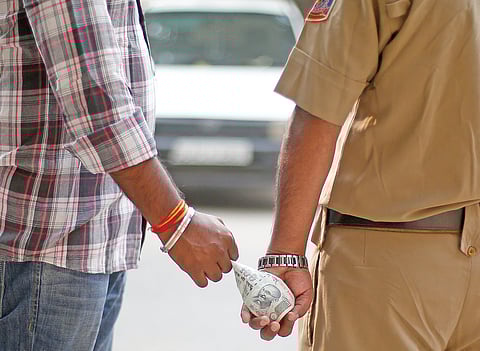

On September 26, Head Constable Kuldeep Tyagi and Constables Ravi, Bijender and Santram from Ranjeet Nagar police station were suspended for extorting bribes from local residents and shopkeepers on various pretexts. They had fixed the monthly bribe money of Rs 800 from shop owners in the locality.
On August 12, Assistant Sub Inspector Tuki Singh from Hauz Qazi police station in the Walled city was suspended for demanding a bribe of Rs 400 from a local resident for a police verification.

The 222-page report, ‘Manpower Assessment of Delhi Police’ by Joint Commissioner of Police Sanjay Beniwal prepared over 14 months by studying all the capital’s 161 police stations sent to the Home Ministry recently shows that acute manpower shortage, duty fatigue and desertions are leading to escalating corruption among cops. This year alone, 350 policemen including 195 officers have been suspended after the Vigilance department registered complaints of taking bribes from people.
Around 12,500 complaints have been registered against police personnel for various reasons including corruption. Vigilance enquiries against 360 personnel have been initiated. Last year, 330 cops were convicted for corruption. The Beniwal report says that of the huge number of complaints against police personnel received by the Vigilance branch of Delhi police, 60 per cent are corruption related. “We all are aware that there are thousands of erring cops in our system. Corruption is deep rooted and needs to be addressed on an urgent basis. But it cannot happen overnight,” Beniwal told The Sunday Standard. The officer also said that Delhi Police, reputed to be the country’s most professional force, has to look within to find a solution. Acknowledging systematic corruption, Vigilance launched the anti-graft helpline number 9910641064 in August. People sent audio and video recordings of police officers demanding bribes on Whatsapp. In just two months, the department was flooded with around 6,000 complaints. Overwhelmed, senior officers ordered that each video and audio should be analysed. But they hit a brick wall. Inquiries could not proceed as the force is plagued by a severe staff crunch and insufficient or moribund infrastructure and budget. The current budget is Rs 5,035.47 crore but only Rs 2,250 crore has been used till now. Of the Rs 4,455 crore budget in 2013, around Rs 150 crore was returned to the Home Ministry because of delay in purchasing law enforcement equipment.
Delhi Police has to oversee 1,483 square kilometres, maintain law and order in 1,642 unauthorised colonies and 1,100 slum clusters. They have to monitor 85 lakh vehicles registered in the city that travel 33,198 kilometres. They also have to attend thousands of court cases every day and help government agencies such as Delhi Development Authority, Municipal Corporation of Delhi, Archaeological Survey of India and many more in the performing of their duties.
OVERWORKED AND UNDERPAID LEADS TO GRAFT Delhi Police officers are one of the most overworked in law enforcement, putting in 16 to 18 hours a day, thereby coming under severe psychological and physical pressure. They do not get leave for weeks and little family time. Almost 80 per cent of police staff have no housing and their salaries—a constable gets Rs 22,000 pm and a sub-inspector gets Rs 32,000 pm—are not enough to rent housing in respectable areas.
“We are of the view that one investigation team would be in a position to investigate 50 cases per year.
We have no doubt that the quality of investigation will be of a very high order considering the reasonableness of the workload”
“In the police station, for every written complaint that they receive, there are more than a dozen complaints which are handled verbally/orally.
This is also evident from the fact that if we look at the complaints recorded at the police station, other than those registered as a case, we find that on an average only 2 complaints are received in the police station. This is simply not believable”
“Ordinary complaints, which may not be heinous/ serious, are usually not given any priority in the police station.
This gives the police an image of an insensitive organization and has resulted in the poor public image of the police”
Cops awaiting promotion
20,000 constables, 10,000 head constables, 1,500 inspectors, 2,000 sub-inspectors and 400 ASIs