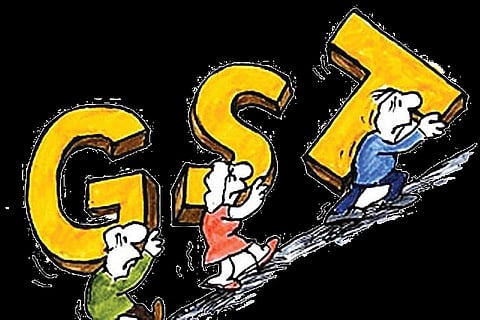

NEW DELHI: Mahesh Verma, 24, who is pursing his final year studies of Chartered Accountancy is clueless about the new indirect tax regime that the government is planning to introduce as Goods and Services Tax (GST) from next year. The industry is, however, slowly rising up to the challenge to address the crucial aspect of training and educating the large group of tax professionals.
As the first step, the Institute of Chartered Accountancy of India—the national accreditation body for CA—has prepared a 400-page booklet for the students that will demystify the various concepts of the new GST, as it will replace all other indirect taxes present in the country.
The institute is also preparing the reference course material for students, which will later be included in the curriculum of most accounts and taxation students. According to experts, this will take time and would happen around five to six months after the bill is passed.
Although, the booklet attempts to provide a basic understanding of GST, it fails to answer many pertinent questions as the government itself is not clear yet on the uniform rate to be levied on products, and its revenue share mechanism between various states and Centre.
Mahesh’s dilemma persists as the booklet does not explain about the accountancy computing formulas of taxes for—pre GST and post-GST regime. Another problem that he faces as a student is that everything he has learnt with various accounting software modules will be redundant now.
As the introduction of GST would change the Indian tax structure and pave way for modernization of tax administration, the government has, therefore, incorporated a company named Goods and Services Tax Network (GSTN), to prepare the backbone information technology (IT) infrastructure needed for a seamless transition.
The software companies, with the help of ICAI and GSTN, are coding new Enterprise Resource Planning (ERP) modules to make ease of doing business transactions and tax computation.
However, the difficulty of getting the Opposition’s support in clearing the GST bill in the Parliament is only half the problem. Atul Kumar Gupta, chairman for Indirect Taxes Committee, told The Sunday Standard, “Even if GST gets implemented in April 2016, the professionals and the entire IT infrastructure will take at least 12 to 15 months to digest the change and understand the various transactions to make business easy.”
Why GST?
As GST will subsume all indirect taxes like sales tax, service tax, entry tax, VAT, into one uniform levy in the country, it will help in reducing prices and boost economic consumption in the country. According to the National Council of Applied Economic Research, government’s tax revenue will increase by about 0.2 per cent because of GST implementation, while GDP growth could go up by 0.9-1.7 per cent.
For example, today if someone goes to a restaurant to have dinner, he pays more than 30 per cent as tax on his consumption, which includes 12.5 per cent VAT on food and 20 per cent on drinks, 14 per cent service tax and service charge with surcharge. Now, if GST is levied say at 18 or 20 per cent, he could save around 10-15 per cent.
However, a consensus is still missing on the final revenue neutral rate and recommendations vary from 12 per cent to 27 per cent.