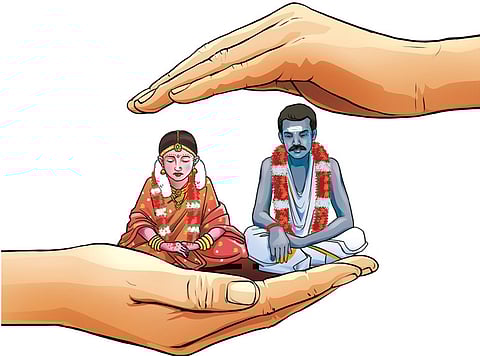

CHENNAI:Voices for creation of a special reservation category for children of inter-caste couples in educational institutions and government jobs have begun to emerge yet again in the wake of increasing cases of such couples being ostracised in Tamil Nadu. Though the Dravidian state had pioneered radical reforms like legitimising Self Respect Marriages in 1967 and leaders like Periyar and Annadurai strongly advocated inter-caste marriages, violence continues to be unleashed against couples hailing from different communities.

In this backdrop, the CPM state council, in its last executive committee meeting, adopted a resolution seeking enactment of a law to provide for separate reservation for children of intercaste couples. “Inter-caste couples have to face opposition from many. Ultimately, they are forced to flee. When they move to another place for livelihood, a special reservation would facilitate them to get social acceptance,” argues K Kanagaraj, CPM state council executive committee member. In 1998, the Justice Mohan Committee, which probed caste clashes, had recommended that the government “consider the children born out of inter-caste marriages as a special category on priority in matters of admission to educational institutions and then government service, provided he/ she possess the prescribed qualification.” Social analysts, however, point out such reforms can’t be introduced in the absence of consolidated data of inter-caste couples in Tamil Nadu.
Confirming this, a senior official of the State Registration Department said the “need for gathering such data had not arisen so far”. Inter-caste marriages are registered at the local Sub- Registrar office, but consolidated figures are unavailable. The only data that is available is with the Social Welfare Department, which inter-caste couples approach to get financial aid. “This figure could be meagre because all intercaste couples may not need aid. The actual number of such couples could be large considering the fact that many do not even register their marriage,” says an analyst.
Societal pressure forces inter-caste couples to give the caste identity of either parent to their children. “To avoid this, such children should be considered as a separate category and reservation must be provided to them,” says the analyst. However, A R Venkatachalapathy, assistant professor at the Madras Institute of Development Studies, disagrees with the need for special reservations. “Parties like the CPM see this social issue mostly from the economic point of view, whereas the root cause lies in denying one’s fundamental rights to marry someone from any caste. The government must ensure this right,” he argues.
Former Lok Sabha MP S K Kharventhan, who had piloted ‘The Inter-caste Marriages (Reservation Provisions Bill’ as a private member in Parliament 10 years ago, laments that the Bill was never taken up for discussion and lapsed when the term of the 14th Lok Sabha ended. “I had moved the Bill after the Kerala High Court held that children born out of inter-caste marriages could not claim benefits of reservation in educational institutions even if one of the parents belonged to a Scheduled Caste/ Tribe,” he recalls. The court had said, “The burden lies on the person who is claiming the benefit of reservation to establish that he was subject to the same handicap and disadvantages as someone born as a member of SC/ST.” This would affect children of divorced couples. “In these cases, children are generally in the custody of mother and they stand to lose the reservation facility enjoyed by them so far,” he points out.