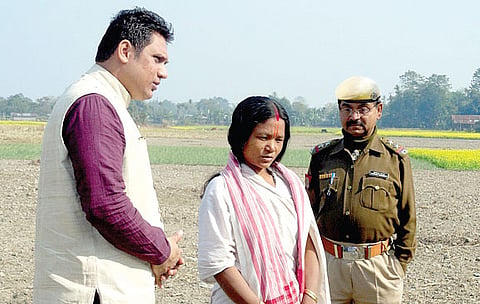

GUWAHATI:The threat to his life notwithstanding, 40-year-old social activist Dibyajyoti Saikia moves around rural Assam with messages of peace, brotherhood and communal harmony. Over 200 people have been killed in the incidents of violence in Bodoland Territorial Areas District (BTAD) over the past three years. In a state ravaged by decades of insurgency and ethnic riots, perhaps no one knows better than Saikia how challenging it is to work in a place where communities have been at daggers drawn for long. When he leaves home for a conflict zone, he is warned by well-wishers as well as the police that he may not be safe. But he remains unfazed.
The secretary general of social organisation ‘Brothers’, Saikia organises meetings on communal harmony and awareness campaigns against witch-hunting across the state. He also works in the flood-affected areas and helps out economically weak but talented students using a fraction of the profits made from his green tea business. A recipient of Babu Jagjivan Ram National Award, Saikia was also arrested once while he was staging a protest along with flood victims.
“In places like BTAD, clashes between communities are a regular phenomenon. Sometimes, they take place even over trifles. There is mistrust and misunderstanding all around, especially after the 2012 ethnic riots that claimed the lives of over 100 people and displaced some three lakh others. Given the cases I studied, I have found politics invariably playing a part. There are elements, which often incite the innocent and illiterate people to gain political mileage,” Saikia says.
“So, when I visit a place and organise a meeting, I tell them that they should not get provoked. I tell them they were being used by the anti-social elements. These areas being very remote and backward, I tell them that their villages will get infrastructure only when there is a semblance of peace,” he says.
However, his meetings do not always go smoothly. Often, he is bombarded with questions on why he could not stop the clashes. People also look at him with suspicion. They suspect that he is only paving the grounding to contest an election. Sometimes, he is intercepted on the way by miscreants who threaten him that if he visits the place again, his life would be in danger. Most of the places that he visits are remote where the militants rule the roost. He has also organised meetings on communal harmony in Madhya Pradesh, Jharkhand, Arunachal Pradesh and Manipur.
Saikia says clashes, which occur in BTAD on a regular basis but on a smaller scale, often go unreported. But, he says, things have improved to a great extent recently. Communities affected by the scourge of violence are slowly bridging the gap that exists between them. He says during the 2012 ethnic riots, there were instances of Muslims giving shelter to Bodo families and vice versa.
Saikia has been extending the yeoman service for the last 15 years. It was only once that he was attacked, when he was organising a meeting after a woman had been banished from a village. Ritumoni Doley used to go to a doctor whenever she or her children fell sick. Some people were angry that she did not go to the village quack. So, they branded her as witch and evicted her. She has since not been able to return to the village. “Escorted by the police, I went to organise a meeting and took along Ritumoni and her husband. When I insisted that she should be allowed to return to the village, around 400 women, some of them armed with machetes and other weapons, came rushing towards me,” Saikia recalls.
During floods, he keeps a hawk eye on the distribution of relief to make sure it reaches the affected thereby ruffling quite a few feathers. His efforts have been recognised by the government as well. Chief Minister Tarun Gogoi called him recently for a discussion when the state witnessed a spurt in witch-hunting cases.
