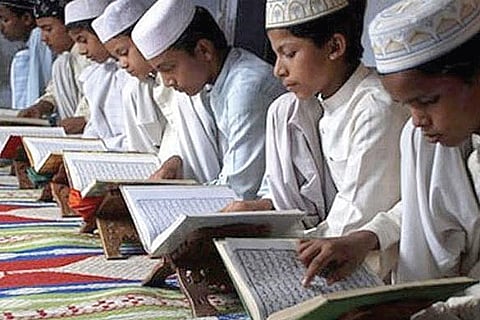

NEW DELHI:The rift between the contemporary and theology has come to the fore among Delhi’s madrasas. The state government wants to bring 5,000 of them into the mainstream education system. But around 30 per cent of them refuse to allow their Islamic curriculum to be modernised at par with other schools where subjects like Science, English and Computers are taught.
The dissident madrasas fear formal education is a threat to Islamic education system and values. Maulana Zafaruddin, who runs Bab-ul Uloom, says, “Many maulanas feel the identity of madrasas and its religious education will be lost and will be overtaken by formal education over a period, if introduced.” He also feels they fear they will become unemployed if the government hires teachers in madrasas. Madrasas in Delhi are run by private players, non-government organisations and various trusts. Of the 5,000, only 124 madrasas like the prominent Sunheri Masjid, Abusidique, Bilal Masjid, Madarsa Ahle, Sunnat Islamia Mohamdia and Fazal-e-Uloom are registered with the Delhi Education Department. Noting that thousands of minority students learning Islamic law and other religious topics in many madrasas are not getting the benefits of modern education, the state government has given the task to the Delhi Minority Commission to bring them into mainstream. “A survey of around 450 madrasas carried out found that 70 per cent of them want to incorporate modern topics with in traditional curriculum,” former IPS officer and Delhi Minority Commission Chairman Qamar Ahmed tells The Sunday Standard. Congress leader and former chairman of Delhi Wakf Board Mateen Ahmad says, “Though many madrasas give degrees equivalent to 10 and 10+2, they have no significance while seeking admission in colleges and institutions.” Some madrasas in Delhi provide Adeeb, Adeeb-E-Mahir and Adeeb-E-Kamil degrees, which are equivalent to Class 10, Class 10+2 and graduation respectively. But they cannot help a student a place in any institute of higher education.
The fundamental purpose of madrasas is to impart theological knowledge and there are no guidelines or law to guide the curriculum. “Under Article 29/30 of the Constitution, there are complete guidelines for minority institutions and schools but madrasas have existed for the past 1,400 years,” says Hamidullah Bhatt, Chairman, India Siksha Mission. He explains that many of them refuse to modernise their syllabus fearing they will be made accountable and will come under government scrutiny. “They get donations from various quarters and once they opt to impart formal education, they will get government funds. Then the money will be audited and they will be held responsible,” Bhatt says.
Qamar Ahmed says many madrasas in Delhi do not want to impart formal education as they lack infrastructure. “Some are run from a single room and their numbers are in the hundreds. In 2009, the government launched the mid-day meal scheme under Sarva Shiksha Abhiyan scheme for madrasas. Only around 70 madrasas applied; 20 are availing the facilities,” he adds.
In the struggle between traditional religious training and modern education that generates career opportunities, the students of traditional madrassas are the victims.