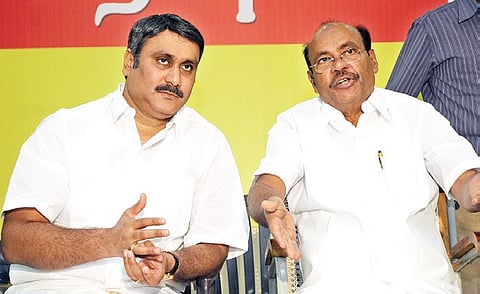

CHENNAI:In Tamil Nadu, the pioneer of quota politics in the country, caste-based political parties are jittery over the release of caste census data while the Dravidian parties are demanding its release as they hope it will provide the key to justify the existing 69 per cent quota for backward communities in Tamil Nadu.
The PMK should be the first party to get exposed as it claims that its core constituency Vanniyars constitute 20 per cent of the population. But, the party had managed to poll only six per cent even at the height of caste mobilisation in 1991 and 1996.
G Muthukumar, a Vanniyar Sangam leader, who is also a PMK functionary, in Ariyalur here, said “The population of Vanniyars will be 20 per cent of the total population. In north Tamil Nadu, it will go up to 40 per cent in Villupuram, Tiruvannamalai, Cuddalore, Vellore, Dharmapuri, Krishnagiri, Kanchipuram and Tiruvallur districts. Vanniyars have been added in the Most Backward Community (MBD) category and provided 20 per cent reservation out of the 50 per cent for backward communities. Many of the castes are added in the MBC category, denying Vanniyars the opportunity for entry into education and government employment. When our population itself is over 20 per cent, Vanniyars should be given 20 per cent quota in the state and 2 per cent in Central government jobs”.
However, S Veeraraja, a functionary of Tamil Nadu Mutharayar Sangam said “Our population would be nearly 20 per cent in the state and more than 35 per cent in Tiruchy and Thanjavur districts. Our community is clubbed in the Backward Community (BC) list and did not get enough opportunities in education and employment.” Besides, the parties of Thevar community in the southern and eastern districts of Tamil Nadu claim that their numerical strength is the highest in the state and nearly quarter of the total population belong to their community. They also claim that it would be an injustice to club them in the BC list along with numerous other communities.
Political parties of Nadars too lay claim for 15 per cent of the population and similar claims are made by the Yadava Mahasabha, of Yadavs in Tamil Nadu. The community which was earlier called Konars had named themselves as Yadavs to get an all India identity. “If the data given by these caste-based political parties are added, it comes to thrice the population of the state. So, the release of caste census would have a positive impact as the real population of various communities will be known. The Supreme Court had already raised questions over fixing 69 per cent reservation based on the 1934 census,” said political commentator Govi Lenin.
However, Viduthalai Chiruthaigal Katchi functionary D Ravikumar disputed the notion that caste census would help to protect 69 per cent reservation in Tamil Nadu. The upper ceiling for reservation is fixed by the Supreme Court for all the states and a relaxation would not be possible for Tamil Nadu alone. The only solution will be allowing the states to fix the reservation for various communities through a legislation in Parliament, he said.
The Dravidian parties, which evolved from the South Indian Non-Brahmin Association popularly called as Justice Party have their roots in reservation. The association was formed based on the demand for educational and employment opportunities for non-Brahmins in the erstwhile Madras Presidency.
Although, reservation for a few dominant communities was provided earlier in Karnataka, quota for the oppressed communities was introduced by the Justice Party through the communal government order when it captured power in the presidency in 1916. Dravidar Kazhagam founder EVR Periyar quit the Congress following differences in the quota issue.
The DMK, formed in 1949 derived its support from the backward communities, a large section of which turned towards the AIADMK. When AIADMK founder MGR questioned the reservation policy and spoke about favouring the economically deprived, he suffered a rout in the 1980 Parliament elections. Subsequently, he raised the quota to 69 per cent. Since then, both the major Dravidian parties are vying with each other to score political points on the reservation issue.
The Story so Far
■ The Dravidian parties, which evolved from the South Indian Non-Brahmin Association popularly called Justice Party, have their roots in reservation. The association was formed based on the demand for educational and employment opportunities for non-Brahmins in the erstwhile Madras Presidency.
■ Quota for the oppressed communities was introduced by the Justice Party through the communal government order when it captured power in the presidency in 1916.
■ The DMK, formed in 1949 derived its support from the backward communities, a large section of which turned towards the AIADMK. When AIADMK founder MGR questioned the reservation policy, he suffered a rout in the 1980 Parliament elections. Subsequently, he raised the quota to 69%
