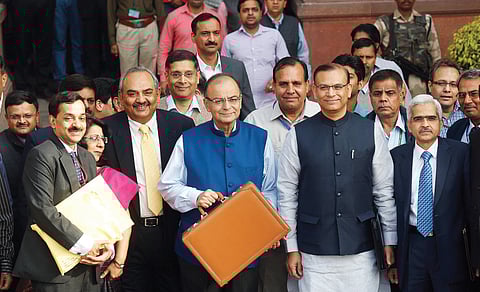

Finance Minister Arun Jaitley Saturday rolled out a please all budget with marginal increase in allocations in infrastructure, agriculture, defence and power.
However, the Budget had some bad news for the middle or the salaried class as the personal income tax slab were left unchanged and the already high service tax was increased to 14 per cent from the existing 12.36 per cent which would make several items costlier including air travel, eating out and paying bills.
Regarding the increase in service tax, which will put additional burden on the already stressed common man, Jaitley said: “To facilitate a smooth transition to levy of tax on services by both the Centre and the States, it is proposed to increase the present rate of service tax plus education cesses from 12.36 per cent to a consolidated rate of 14 per cent.” While emphasising the need for a balancing act between infrastructure and welfare spending, Finance Minister Arun Jaitley today said the BJP-led government is “pro-poor and pro-industry”. Jaitley said his challenge was to maintain balance between growth and keeping a check on fiscal deficit.
“We are concerned about building infrastructure and maintaining growth rates....Industry should grow fast...If I do not earn from the industries, how will I serve the poor?” the Finance Minister said.
Jaitley, while presenting his budget, enumerated the challenges that lay ahead for the country and said, “I am also mindful of the major challenges I have to reckon with. Agricultural incomes are under stress. Our second challenge is increasing investment in infrastructure. With private investment in infrastructure via the public private partnership (PPP) model still weak, public investment needs to step in, to catalyse investment.
The government continues to attach very high priority and importance to infrastructure and proposed Rs 70,000 crore increase in investment to boost growth. Jaitley also increased budgetary support for Roads by Rs 14,031 crore and to the Railways by Rs 10,050 crore. He added that they would consider ‘plug-and-play’ projects in infrastructure projects such as roads, ports, rail lines, airports etc. In the 2013-14 budget, Jaitley had proposed an investment of Rs 37,880 crore including Rs 3,000 crore for North East.
He also announced that bids for five new ultra mega power projects (UMPPs) at an estimated cost of Rs 1 lakh crore would be rolled out in the future, however the states where these UMPPS would come up weren’t mentioned in the Budget. The government, last year, invited bids for two UMPPs. These were not successful as bidders opted out because they did not find the terms and conditions favourable.
Regarding the fiscal road map, the Finance Minister said while FY15’s fiscal deficit target of 4.1 per cent of GDP or Rs 5.12 lakh crore can be met, the government’s plan to reduce fiscal deficit to 3 per cent has been delayed by one year, to April 2017 from the earlier projection of April 2016.
Total expenditure is estimated at Rs 17.77 lakh crore including defence and internal security, while gross tax receipts are likely to hover around Rs 14.5 lakh crore. Plan expenditue is cut by Rs 1.07 lakh crore of the budgeted Rs 5.75 lakh crore and non-plan expenditure for the current fiscal is at Rs 13.12 lakh crore. Defence budget was increased by 10.95 per cent to Rs 2.46 lakh crore, and agriculture credit target was raised by Rs 50,000 crore to Rs 8.5 crore for FY16.
This investment push is perceived as necessary as the world’s predicting that it is India’s chance to fly, and any government expenditure will likely spur investment and usher growth.
He added that there is “always a hollow debate” in the country on whether the government is pro-poor or pro-industry. “I am in favour of both... I don’t think there is any conflict between the two. I believe both can walk together,” he said.
To provide a social security cover for economically weaker sections, the Finance Minister rolled out an accidental insurance scheme with a premium of Rs 1 per month or Rs 12 per year.
While Jaitley removed wealth tax, he levied a 2 per cent surcharge on those earning over Rs 1 crore per annum. This is supposed to fetch the government additional revenue of about Rs 9,000 crore.
The Finance Minister assured removing structural bottlenecks to bring in ease of doing business and stated that corporate tax rate was being reduced to 25 per cent from the current 30 per cent in the next four years, the incentives to boost investor confidence and make India more competitive with its ASEAN counterparts.
“Corporate tax has been slashed to attract investments, both global and domestic,” he said, adding that South East Asian economies are strong competitors with lower tax regimes.