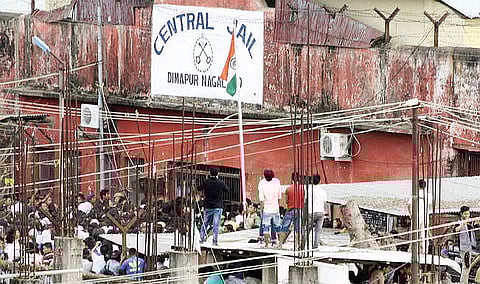

DIMAPUR (NAGALAND):The issue of illegal Bangladeshi immigrants in India’s Northeast is a ticking bomb. And after Assam, Nagaland seems set to explode.
The ugly face of the anti-illegal Bangladeshi immigrant sentiment brewing in the state was exposed last week when a 10,000-people strong mob lynched a Bengali Muslim from Assam, accused of raping a Naga girl, thinking he was a Bangladeshi immigrant. On March 5, the mob broke into the Central Jail in Dimapur and dragged out Syed Sharif Khan. He was paraded naked to the town tower and then bludgeoned to death and lynched as many in the mob took pictures and made videos of the barbaric killing.
In a fresh twist on March 12, the Nagaland government told the Centre that Khan did not rape the girl who had accused him, adding they had consensual sex twice that Khan had paid for. According to the report, Khan had also told the police the girl, seen in CCTV footage entering a hotel with him, had demanded more money after the sexual encounters which he had refused. An FIR of rape was filed soon after.
There is a growing perception in the Northeast that all Muslims speaking Bengali are Bangladeshis. When Khan was arrested after the girl’s family filed an FIR even cops had dubbed him an IBI (Illegal Bangladeshi Immigrant), a recently-coined term used increasingly by all and sundry in Nagaland to refer to Bengali Muslims. The fact that Khan, a long-time resident of Dimapur, was married to a Sumi Naga woman and has a three-year-old daughter, and belonged to a family of Army men is only now being discussed. One of his brothers was killed fighting in the Kargil War. His late father had served in the Indian Air Force.
In the aftermath of the lynching, some 1,000 Bengali Muslim families are said to have fled the town. “The traders here are already tormented by the scourge of extortions by extremist groups. Now they (the Nagas) call us IBIs. Most of us are from Assam. Isn’t Assam a part of India?” asked one Bengali Muslim trader.
The Muslim Council Dimapur has appealed to the state government to solve the problem once and for all. “Back in 2012, we had appealed to the government to formulate laws for the regulation of migrants of all communities but nothing has been done,” rued the Council’s working president A Rahman.
Dimapur is Nagaland’s largest town and commercial hub. The Nagas say the Bengali-speaking Muslims constitute at least 10 to 15 per cent of its five lakh population. This excludes the floating population of the community. The retail trading here is controlled by Bengali Muslims, who are also a presence in rest of the towns in the state. Nagaland is one of the “protected” states in India and it is mandatory for any Indian citizen to obtain an official document called Inner Line Permit (ILP) to enter the state. But ILP is not required to visit or stay in Dimapur. The Nagas say this has largely contributed to the influx of immigrants.
Back in 2008, hundreds of Bengali Muslims, especially traders, were driven out of the state’s Mokokchung town due to such a campaign. Nowadays such campaigns are carried out via the social media, which is believed to have played a part in whipping up the anti-IBI sentiment. Anti-IBI Naga organisations feel the problem of illegal immigration should be nipped in the bud.
An organisation named Survival Nagaland, formed a year back by a group of educated Nagas, has been carrying out a systematic campaign to create awareness on the influx of illegal Bangladeshi immigrants. “IBI is a Naga issue. The success in curbing the menace will depend much on the cooperation of all sections of the society and the government. The Survival Nagaland has been raising awareness on the imminent threat posed by the IBI population,” a Survival Nagaland spokesman told The Sunday Standard. “But we are not against any community or religion,” he added.
The influential Naga Council of Dimapur believes Khan’s lynching had nothing to do with the problem of IBIs. “He was killed because he was a rapist,” the Council president T Bangerloba asserted. The state’s apex social organisation Naga Hoho said the lynching incident was not to scare away the Muslims. “The youth in the state are very serious about the problem of IBIs. A strong sentiment is building against them,” said Naga Hoho president Chuba Ozukum.
The police attribute the people’s anger to the rising numbers of the IBIs. “The people are angry to see their numbers growing, their involvement in criminal activities and collection of (illegal) taxes on behalf of the extremists,” a senior police official said requesting anonymity.
The social media had played a key role in uniting the Naga youths against the rape accused before and after the lynching incident. As gory photos and videos of the incident went viral on the social media, the state government temporarily blocked Internet, SMS and MMS services. But given the mood on the ground, the anti-IBI hatred is only going to intensify in the time to come.
Who was Syed Sharif Khan?
A long-time resident of Dimapur, Khan was a Bengali Muslim from Assam who was married to a Sumi Naga woman and was father to a three-year-old girl. He hailed from a family of Army men. One of his brothers is serving in the Indian Army while another was killed fighting in the Kargil War. Their late father had served the Indian Air Force.
Illegal Bangladeshi Immigrant or IBI:
A recently-coined term used increasingly by all and sundry in Nagaland to refer to Bengali Muslims. Even those from Assam are dubbed as Bangladeshis.