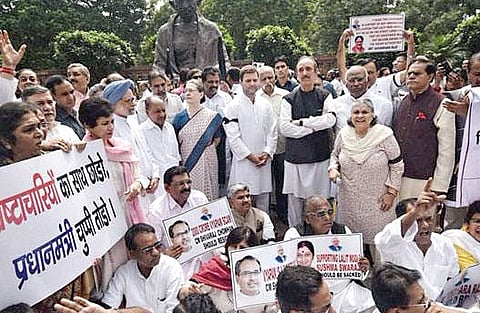

The charges and counter-charges about who is responsible for the logjam in Parliament are reminiscent of intercollegiate debates between St. Xavier’s and Elphinstone College. External Affairs Minister Sushma Swaraj makes an emotional statement in Parliament and enquires what Sonia Gandhi would have done to help a dying cancer patient, Lalit Modi’s wife, if she were in her place. Sonia Gandhi retorts outside Parliament, saying “Sushma Swaraj is doing drama, she is an expert in theatrics”. Not to be outdone, Rahul Gandhi remarks that “Sushmaji made a very eloquent but a very hollow speech. She spoke when the Opposition was not in House”. He further insinuated that Swaraj was guilty of graft because “when a theft occurs, two things take place. Whatever happens is in secrecy and there is a financial transfer”. He demanded that “Sushmaji should tell the country how much money her family, her daughter and husband got from Lalit Modi to keep him out of jail”, quite oblivious of the fact that Sushmaji is more than willing to do so in Parliament if the Opposition allows it to function. Next in the fray is HRD Minister Smriti Irani who thundered that in the Gandhi family no one has to sweat it out in the sun to earn their livelihood. Referring to the ‘boys’ of the Congress who had removed their shirts to protest naked against the Speaker’s decision to suspend 25 Congress members, Irani wondered if these were the values that Rahul wanted the Congress to absorb. And the exchanges go on nauseatingly outside Parliament, whereas the proper place to attack Swaraj would be in Parliament.
The logjam has cost the nation a few crores. An ordinary citizen without any political affiliation is sick and tired of watching this deplorable spectacle and expects Parliament to pass important legislation about which there is no substantial disagreement. Is that too much to expect?
Capital Punishment: The Tripura Assembly has passed a resolution requesting the Centre to abolish capital punishment. Chief Minister Manik Sarkar stated that it is like murdering someone for committing a murder.
The debate about the death penalty is ancient and endless. Two cogent reasons against imposition of the death penalty are (a) fallibility of human judgment and irreversibility of the sentence; (b) the State manipulating prosecution and fabricating evidence to secure conviction and imposition of death penalty on political adversaries and dissenters, thus putting them out of the way. But take a case where a person admits that he has committed the horrific crime which resulted in the death of numerous innocent persons, including elderly people, women and children. Moreover, because of his mental indoctrination, the convict expresses no remorse but defiantly states that he would commit the same crime again if he gets the opportunity because he believes it to be his divine mission. The question is whether such deadly persons with perverted mindsets should be housed and fed at the expense of taxpayers? Besides, there is always the risk of a terrorist operation to secure the release of the convict. In such cases, it is not baying for blood by retributive justice but a question of self-protection of society. Retention of death penalty in such exceptional situations and in respect of horrific crimes against society may not be unjustified. There are no easy answers, however.
1975 Emergency: It is unfortunate that the present generation has no comprehension about the genesis of the spurious 1975 June Emergency that was foisted on the nation by the Indira Gandhi Congress government. Fortunately, there are a few books which have dealt with this phenomenon, like Coomi Kapoor’s The Emergency: A Personal History. It is heartening that poets risking their lives and liberty protested against the Emergency. The book Voices of Emergency: An All India Anthology of Protest Poetry of the 1975-77 Emergency is truly remarkable. It contains the resistance poetry of 250 poets in 15 languages. One moving poem is by Malayalam writer M Govindan written in 1976, Prayer. It is regrettable that the book has been out of print since 1983. Every effort should be made for reprint of this invaluable work.
solisorabjee@gmail.com