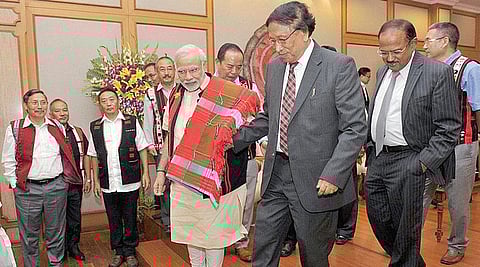

GUWAHATI: The Centre may consider its peace accord with the Isak-Muivah faction of insurgent group National Socialist Council of Nagaland (NSCN-IM) as historic, the Nagas, however, are a confused lot. They don’t know how to react to the August 3 accord, and this is primarily because of the non-disclosure of accord’s contents.
The Nagas insist on a settlement to the six-decade-old ‘political problem’ by taking all the Naga insurgent outfits on board. They believe that a piecemeal solution will only open up the can of worms, given that there are four other armed groups active in the state. They argue that the accord, signed with NSCN-IM, may not necessarily be acceptable to the other groups.
For instance, the Khaplang faction of the NSCN, which went back to old ways by unilaterally abrogating its 14-year-old ceasefire with the Centre in March, has stuck to its demand for “Naga sovereignty”.
So far, only the Khole-Kitovi faction of the NSCN has reacted. “The Prime Minister was saying that the accord is based on the mainstream, which Muivah (NSCN-IM general secretary) accepted. They have not addressed the political issue,” Alezo Venuh, a leader of the group, told The Sunday Standard.
“We have to see the accord’s contents. The integration of the contiguous Naga-inhabited areas (for the creation of Greater Nagaland) is surely not going to happen. The agreement was based on peace and development, but that is not what the Nagas have been fighting for,” he said.
The peace deal, Venuh claimed, is confined to the state of Nagaland. “So, how does Muivah represent the state? He is not from Nagaland,” the insurgent leader questioned. He, however, added that integration remains their ‘wish and dream’.
Muivah, a Tangkhul Naga, is from Ukhrul district of Manipur. The Nagas are in a majority in Ukhrul, Tamenglong, Chandel and Senapati districts of Manipur and Tirap, Changlang and Longding districts of Arunachal Pradesh. They also have sizeable population in Assam’s Dima Hasao and Karbi Anglong districts. The Nagas envisage the creation of Greater Nagaland by slicing off the Naga-inhabited areas of these states and parts of Myanmar.
The Centre insists that the accord would not hurt the three neighbouring states, but it has not gone down well with the Chief Ministers of Assam and Manipur.
“We welcome the accord. But we will, under no circumstances, accept it if it disturbs the territorial integrity of Manipur,” Manipur’s Chief Minister Okram Ibobi Singh said recently.
“It may be made confidential before signing, but after signing the content should have been made public. The Manipur government was kept in the dark about it. They (the Centre) neither informed nor discussed with us before signing the accord. Therefore, we are waiting for the Central government to share documents with us,” he added.
Echoing Ibobi, his Assam counterpart Tarun Gogoi said it was astonishing that the clauses of the accord were not made public.
“I don’t know what exactly the peace agreement contains. So I cannot make any comment, but if it affects the interests of Assam, I will oppose it tooth and nail. Being the CM of a state that is on the map of the NSCN-IM, I should have been consulted because the NSCN-IM has been trying to include the territory of Assam in its so-called Greater Nagaland,” Gogoi added.
The NSCN-IM, however, has come up with the ‘compulsion’ theory. They have made it clear that the circumstances compelled them to sign the accord.
“Isak Chishi Swu (NSCN-IM chairman) is seriously ill and is admitted in a hospital in Delhi. Because of his deteriorating health condition, we formed a second opinion among ourselves that we would do something before he departs. Later, his condition improved and he could sign it in sound mind and body,” the outfit’s Kilo Kilonser (Home Minister) R H Raising said at their general headquarters Camp Hebron in Nagaland’s Peren district.
He admitted the NSCN-IM and the Centre were in the ‘final stage’ of their political negotiations and would now discuss other issues based on the principled agreement ‘which is the preamble of the agreement’.
Asked about the other groups, Raising said the problem was not with the NSCN-IM but with them.