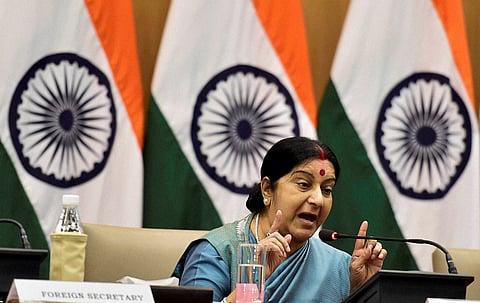


At 4.46 pm, dressed in an opal blue saree and her trademark matching waistcoat, India’s feisty External Affairs Minister, 63-year-old Sushma Swaraj, sitting on the raised podium in the Ministry of External Affairs’s (MEA) hi-tech CB Muthamma auditorium—named after India’s first woman IFS officer—declared, “To baatchit nahin hogi” (then the talks will not be held). She was answering a query on whether NSA-level talks will go ahead if Pakistan doesn’t agree with India’s conditions—talks will focus only on terrorism and that Hurriyat has no role in dialogue between the two countries. Less than three hours ago and about 680 km away in Islamabad, Pakistan Prime Minister’s Advisor on National Security and Foreign Affairs, 86-year-old Sartaj Aziz had grandstanded that he was “prepared” to leave for India “without preconditions”. Swaraj snapped back: India had no preconditions and just wanted Pakistan to adhere to the “spirit” of the 1973 Simla Agreement.
“Why is Pakistan bringing in a third party?” she questioned the hostile neighbour’s intentions. “You are welcome to Delhi. But don’t expand the agenda beyond terrorism,” Swaraj told Aziz.
This marked Swaraj’s debut into the contentious arena of Ind0-Pak fencing on the K word in talks. India had squarely put the focus on terror in its talks with Pakistan, making the Hurriyat irrelevant to the MEA’s stand. This is not a coincidence, but a deliberate strategy to turn the screws on Pakistan to ensure that the spotlight remains on Islamabad’s continuing support for terror proxies which target India.
The strategy puts Pakistan on a backfoot, as it is facing international heat for being the wellspring of global terrorism. Last week, the US warned Pakistan that it would freeze funds because it felt the anti-terror operations by the Pak Army were not yielding results and not damaging the Haqqani network.
On Saturday, Aziz was on tricky ground. On one hand, any move that makes India look like a rational and mature negotiator in front of the international community will obviously not play well in Islamabad. Swaraj’s stand has given the impression in the eyes of the world that India is willing to talk and its insistence on terror being first on the agenda in a round of many subsequent talks is not without substance since all major powers engage with Pakistan through the prism of the War on Terror. On the other hand, by refusing to talk exclusively on terror, Aziz has further reinforced this perception. If the Nawaz Sharif government agrees to India’s terms excluding Kashmir, he would be on shaky grounds with the Army and the hardliners at home.
The detention of Hurriyat leader Shabbir Shah on his arrival at the Delhi airport was a signal that India will not let separatists become part of the Pakistani effort. Its High Commission had invited the Hurriyat leaders to a reception for Aziz on Sunday night, as well as an early morning meeting the next day. In his press conference, Aziz alleged that it was “India which introduced a new condition through its ‘advice’ that Pakistan should not meet Hurriyat leaders, thus assuming the right to determine the guest list for the High Commissioner’s reception”.
Sources said the Pak High Commission has booked rooms at Taj Mansingh hotel in Delhi for the delegation, with Aziz scheduled to reach Delhi at 3.30 pm on Sunday. Aziz claimed that Pakistan was “not running” away from the talks, to be held at Hyderabad House, because Indian NSA Ajit Doval would be presenting ‘irrefutable’ evidence about the ISI’s role in fomenting terror.
Aziz was playing a contortionist in the dialogue circus, at the instance of his government which came under heavy criticism for not mentioning Kashmir in the Ufa statement drafted when PMs Narendra Modi and Sharif met on July 10 in Russia.